
 Lietuviškai
 Deutsch
 Français
 Русский
 Español
 Polski
 Italiano
 Українська
 Čeština
 Português
 日本語
 Latviešu valoda
 Eesti
 Magyar
 Bahasa Indonesia
 Türkçe
 हिन्दी
 Ελληνικά
 العربية
 ไทย
 Tiếng Việt
 Română
 Bahasa Melayu
 বাংলা
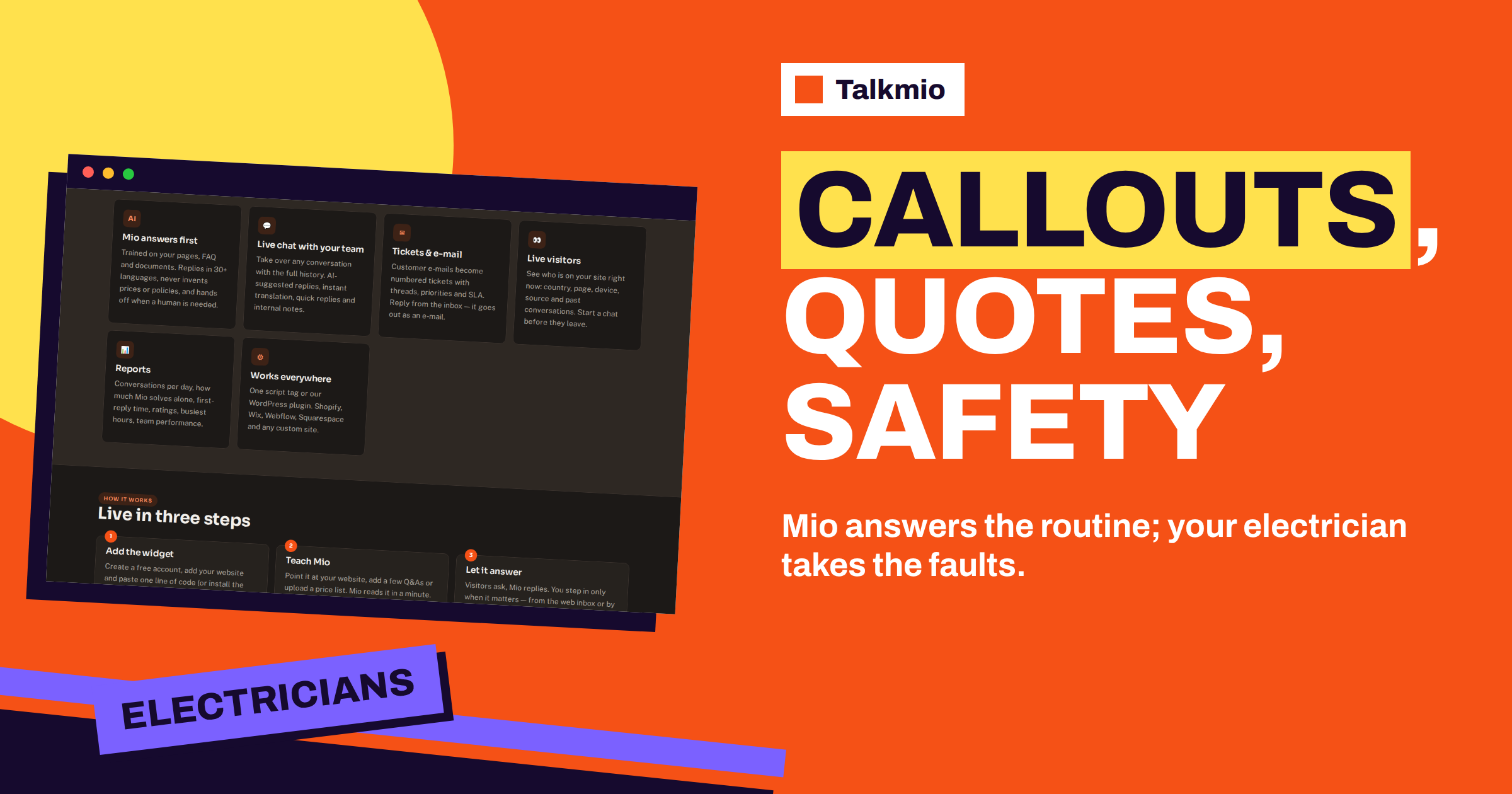
An electrician chat is read at awkward times. A homeowner types from the sofa at nine in the evening because a socket has stopped working. A landlord writes during lunch to ask for a certificate before a new tenant moves in. A builder wants a quote for a rewire and asks whether you cover his town. Meanwhile the electrician is up a ladder with both hands full, and the phone is in the van. This guide shows how to use Talkmio so that Mio, the AI assistant, answers the repeated questions from your own pages, at any hour, while faults, quotes and anything that touches safety go straight to a person who can judge them. The aim is a chat that is helpful and never plays electrician.
Product facts come from the Talkmio documentation and the pricing page. The trade examples are general patterns. Your own prices, areas, qualifications and rules always come first, and electrical rules differ by country, so nothing in this guide is technical or legal advice.
What People Ask an Electrician
The questions fall into groups, and each group has a natural owner. The table sorts them.
| Question group | Examples | Who should answer |
|---|---|---|
| Services and areas | Do you do rewires, fuse boards, lighting, EV chargers? Which towns do you cover? | Mio, from your service and area pages |
| Callout and prices | What is the callout fee? Do you charge by the hour? | Mio, from your price page |
| Quotes | How much for a rewire? Can you quote for a new kitchen circuit? | A person, usually after a visit or photos |
| Faults and tripping | My power keeps tripping. A socket is warm. A light flickers. | A person, with a safety message first |
| Emergencies | Burning smell, sparks, water near electrics | Emergency services first, then a person |
| Certificates and paperwork | Do you issue certificates? How long does an inspection take? | Mio for the process; a person for a case |
| Availability | Can you come tomorrow? How long is the wait? | A person, who knows the diary |
| Payment and warranty | Do you take cards? Is the work guaranteed? | Mio, from your terms page |
The documentation says Mio answers only from your content and never invents prices or policies. It lists the cases in which Mio hands the chat to a person: when it cannot answer from your content, when the visitor asks for a person, when the visitor complains or when the visitor asks about a specific order. For an electrician chat, a question about a particular fault or a particular job belongs to the team, and the rules below make that explicit.
Teach Mio Your Services, Areas and Prices
Sign in, open Mio AI and then the Knowledge base. Add your website, and Mio reads every public page on the same domain, respecting robots.txt. Then check that your pages say what customers ask. A services page should list the work you do in plain words and say what you do not do. An areas page should list towns or postcodes. A prices page should state the callout fee, whether you charge by the hour and what a certificate costs, if you publish those numbers. A short page on how a job runs, from first call to certificate, answers many questions before they are asked.
Add question and answer pairs for facts that sit nowhere else, for example “Do you work on weekends? Yes, by arrangement; ask the team.” The documentation lists Q&A pairs and free text as sources, plus files such as PDF, DOCX, TXT, MD, CSV and HTML up to 15 MB, so a price list or a certificate sample can be uploaded. The plan limits how many pages Mio keeps: 20 on Free, 200 on Pro. Our guide to live chat for home service businesses shows how neighbouring trades organise their pages.
Write the Safety Rules First
The business instructions tell Mio what you sell, which tone to use and what it must never promise. In an electrician chat, safety rules come before everything else. Suggested rules:
- Never diagnose a fault, and never advise a visitor to open, repair or test any electrical equipment. Say that an electrician will look at it.
- If a visitor mentions burning, sparks, smoke, an electric shock or water near electrics, tell them to put safety first and to call the emergency services, then hand the chat to a person.
- Never give a fixed price for a job that needs a visit; explain how quotes work and hand the chat on.
- Never promise a time of arrival or a date; availability comes from the diary and a person.
- Never state what a regulation requires beyond the exact words on your own pages.
Test the rules in Try Mio, which shows the answer, which knowledge pieces were used and how long it took. Ask the dangerous ones: “My socket is hot, can I just keep using it?” and “Can I swap the fuse myself?” The right behaviour is a calm safety message, no technical advice and a hand-off. Our guide to writing AI chatbot instructions shows how to word rules that hold. For background on the trade, see the overview of the electrician.
Quotes: Collect the Details, Let a Person Price
Most electrical jobs cannot be priced from a chat. A rewire depends on the house, a fuse board upgrade on the existing board, and an EV charger on the cable run. A good electrician chat does not guess. It explains how you quote, whether by visit, by photos or by a short call, and it collects what your team needs: the type of job, the address area, the age and type of the property, any photos the visitor can send afterwards, the best time to call and a phone number or e-mail. Then it hands the chat to a person.
Write that list as a short free-text source so that Mio asks for the same details every time. A quote request that arrives with the right information saves one phone call, and a visitor who has been asked sensible questions feels looked after. Our guide to quote requests in live chat goes deeper on the flow.
A Sample Evening
It is half past eight. A visitor asks whether you cover a nearby town, and Mio answers from the areas page. She asks what the callout fee is, and Mio repeats the price page. Then she writes that the kitchen sockets keep tripping the power. The rule applies: Mio gives a short safety message, says an electrician will look at it, asks for a phone number and an address area and hands the chat on. It reaches the Inbox with a “needs human” badge. Nobody is online, so the visitor was asked for an e-mail before her first message, an e-mail and a push notification reach the team, and the reply the next morning goes out as an e-mail. The routine questions were answered at once, and the fault reached a person who could judge it.
Emergencies and Out-of-Hours Calls
Decide, and write down, what your business does about emergencies. Some electricians offer an emergency service with a phone number. Others do not, and the honest answer is to call the emergency services or the distribution network operator for a power cut. Whichever applies, publish it on one page and let Mio repeat it word for word. Never let Mio improvise on an emergency. The documentation describes a status you set for each team member: Online, Away or Offline, and business hours you set for the widget. Use the hours to say what visitors can expect, and use the offline text to point to the emergency number if you have one.
If you do run an out-of-hours service, a small free-text source helps: when it applies, what it costs and which number to call. Check it against the price page every season, because an out-of-date emergency fee in a chat is worse than no fee at all.
Certificates, Inspections and Paperwork
Landlords, estate agents and buyers ask about certificates, and the answers repeat. Publish what each document is called in your country, who needs it, how long an inspection usually takes and what you need from the customer before you come. Mio repeats it. A specific case, such as “Is my certificate valid for this tenant?”, goes to a person, because validity depends on dates and rules that you must check. The same applies to residual-current devices and similar technical topics: let your pages explain what you offer and leave the judgement to the team.
Plan, Test and Launch Your Electrician Chat
Write twenty questions as customers would type them: areas, services, callout fee, quotes, EV chargers, fuse boards, a tripping circuit, a burning smell, certificates, weekend work, cards and warranty. Run them in Try Mio and fix the gaps. Then test the hand-off in a private window with a request for a person. A sole trader can start on the Free plan, with one operator, one website, 50 AI answers a month and 20 knowledge base pages. A firm with several electricians and an office will look at Pro, with three operators, 1000 AI answers a month, 200 pages and the e-mail channel. Check the pricing page for current plans.
Keep a routine after launch. Open Unanswered each morning, assign each conversation and set the priority: a tripping circuit comes before a quote for next month. Once a week, read five conversations under Mio replied and check that no advice or promise crept in. Reports show conversations per day, the share answered by Mio alone, hand-offs and the busiest hours in your time zone; for an electrician chat, evenings are usually the busiest. The mobile app shows the Inbox on your phone, with push notifications for hand-offs, which suits a person who spends the day on site.
Tone, Trust and What Makes an Electrician Chat Feel Professional
People who write to an electrician are often anxious. Something has failed in the house, or they are about to spend money on work they cannot judge. A good electrician chat sounds calm, plain and exact. Ask Mio, through the business instructions, to use short sentences, to avoid jargon unless the visitor uses it first and to say clearly when a person will take over. Add the facts that build trust and are true for your business: how long you have been trading, which qualifications you hold, whether the work carries a guarantee and whether you carry insurance. Mio repeats them from your pages and never adds a credential you did not publish.
Photos and names matter less in a chat than clear promises. State your working hours on the page and in the widget settings, and make the offline text honest about when you reply. If the electrician chat tells a visitor that someone will reply the next morning, make sure someone does. The Inbox helps with this: the filter Unanswered shows everything waiting, and the response time target under Settings gives a conversation without a first reply an “overdue” badge. Trust comes from the follow-through, and the chat only makes the first step easier.
Finally, keep one person responsible for the content. When prices, areas or certificates change, that person updates the page, uses Re-read on the source and tests a question in Try Mio. A small habit like that keeps an electrician chat accurate for years.
Frequently Asked Questions
Can Mio tell a customer what is wrong with their electrics?
No, and it should not. Write a rule that Mio never diagnoses a fault or advises any repair. It gives a short safety message, says that an electrician will look at the problem, collects a contact and hands the chat to your team in the Inbox.
What should the chat do if someone mentions sparks or a burning smell?
Write a rule that Mio tells the visitor to put safety first and to call the emergency services, then hands the chat to a person. Keep the wording on one page so Mio repeats it exactly and never improvises on an emergency.
Can Mio give a price for a rewire or an EV charger?
Only if you publish a price. Most electrical jobs need a visit or photos, so Mio explains how you quote, collects the job type, area and contact details and hands the chat to a person. Mio never invents prices, and the documentation says it answers only from your content.
Will the chat work when the whole team is on site?
Yes. Mio answers routine questions from your pages at any hour. When nobody is online, visitors are asked for an e-mail before the first message, the team gets an e-mail and a mobile push notification for hand-offs, and the reply goes out as an e-mail.
Which languages can an electrician chat handle?
Mio replies in the language the visitor writes in, including Lithuanian, English, German, Polish, Russian, Spanish, French and more than thirty others, from your content. Test safety wording in Try Mio in the languages you expect to see.
Which Talkmio plan suits a small electrical business?
Start on Free: one operator, one website, 50 AI answers a month and 20 knowledge base pages. When several electricians share the Inbox, or you need the e-mail channel and more answers, look at Pro with three operators and 1000 answers a month.
The Bottom Line
An electrician chat works when it answers services, areas, callout fees and paperwork from your pages and sends faults, quotes and emergencies to a person, with safety rules written first. Publish your pages, write the rules and test twenty customer questions before you go live. Start free with Talkmio and let customers get an answer on the evening they ask.