
 Lietuviškai
 Deutsch
 Français
 Русский
 Español
 Polski
 Italiano
 Українська
 Čeština
 Português
 日本語
 Latviešu valoda
 Eesti
 Magyar
 Bahasa Indonesia
 Türkçe
 हिन्दी
 Ελληνικά
 العربية
 ไทย
 Tiếng Việt
 Română
 Bahasa Melayu
 বাংলা
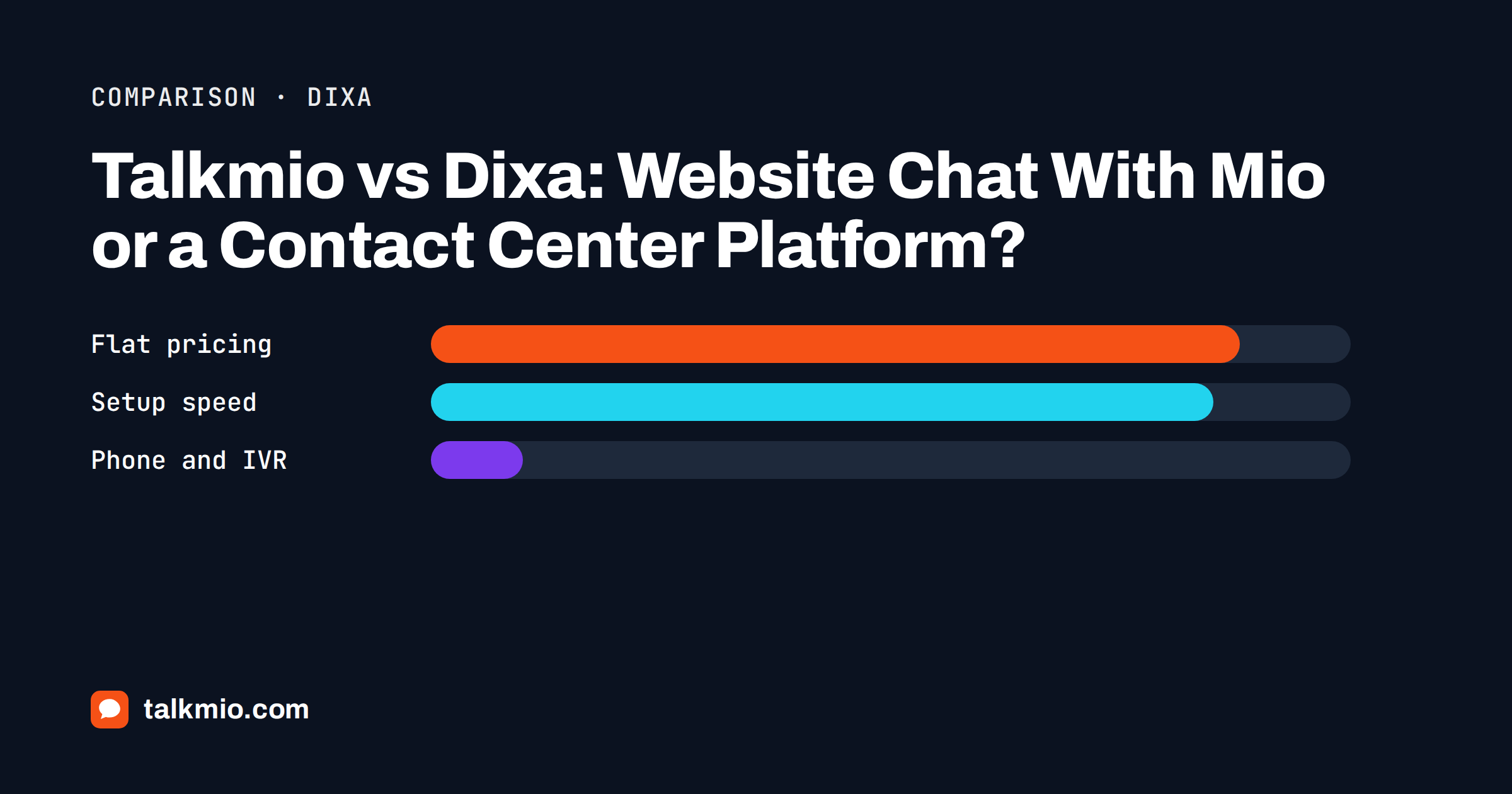
Talkmio vs Dixa is a comparison between a lightweight AI website chat and a contact center platform for consumer brands. Talkmio puts a chat widget on your site, lets an assistant called Mio answer from your own pages and documents, and gives a small team an inbox with tickets and live visitors. Dixa, according to its own pricing page, combines a helpdesk, a contact center with phone, e-mail, chat and social channels, and an AI agent called Mim, priced per agent per month. They both answer customers, but they are built for very different team sizes and budgets. This article compares them on what decides a purchase and says plainly who should choose which.
Everything about Dixa below comes from its public pricing page at the time of writing, and everything about Talkmio from the live Talkmio pricing page. Check both before you decide, because plans and prices change.
Talkmio vs Dixa at a Glance
| Question | Talkmio | Dixa |
|---|---|---|
| Starting point | Website chat with an AI assistant, tickets and live visitors | Contact center and helpdesk with phone, e-mail, chat and social |
| Pricing model | Flat plans with included operators and AI answers | Per agent per month, with AI priced per conversation |
| Entry price | Free plan; Pro at 19 euro a month; Ultimate at 49 euro a month | Growth at 89 euro per agent per month; Ultimate at 139; Prime at 179 |
| Free plan | Yes: 1 operator, 1 website, 50 AI answers a month | Not shown; plans lead to a demo |
| Phone and IVR | No | Yes: phone, IVR, call recording and callback |
| Website chat | The core product | One channel among several |
| AI | Mio answers from your content; included on every plan | Mim AI agent included, with higher plans adding more AI features |
| Typical buyer | Small and mid-size websites and shops | Consumer brands with larger support teams and phone volume |
The table already suggests the answer for most readers. If your customers mostly arrive on your website and your team is small, Talkmio is the simpler and cheaper fit. If you run a team of agents that handles phone calls as well as digital channels, Dixa is built for that.
What Talkmio Does
Talkmio is an AI live chat for websites. Mio reads your website, FAQ and uploaded documents such as PDF, DOCX, TXT, MD, CSV and HTML files, answers visitors in their language and hands the conversation to your team when it cannot answer, when the visitor asks for a person, complains or asks about a specific order. The Inbox has filters, assignment, priorities, statuses, internal notes and quick replies, and every conversation can become a numbered ticket. The Visitors page shows who is on your site right now and lets you start a chat.
Beyond the website, Pro plans add an e-mail channel that turns customer e-mails into tickets, and Ultimate plans add Facebook, Instagram and WhatsApp channels, reports export and API access. A mobile app for iOS and Android provides the inbox and push notifications. Data is stored on servers in the EU, in Germany.
What Dixa Does
Dixa describes itself as agentic customer service for high-performing consumer brands. Its pricing page lists a contact center that includes phone, e-mail, forms, chat and social channels, a knowledge base, intelligent routing, IVR, call recording, customer callback and voicemail, service level agreements, agents, teams and custom workloads, plus native integrations with tools such as Shopify and Klaviyo. A Mim AI agent, helpdesk and contact center are described as part of every plan.
Higher plans add routing based on external data, knowledge-centred service, AI intent detection, skills-based routing, sandbox access and, at the top, single sign-on, auto redaction, custom user roles and enterprise API limits. In short, Dixa is a system for running a service department with phone and digital channels together, and it is designed around teams of agents.
Pricing: Flat Plans or Price per Agent
This is the clearest difference. Talkmio shows flat monthly plans in euro. The Free plan costs nothing and includes one operator, one website, 50 AI answers and 50 tickets a month. Pro is 19 euro a month with three operators, three websites, 1,000 AI answers and unlimited tickets. Ultimate is 49 euro a month with ten operators, ten websites and 5,000 AI answers, and larger Enterprise plans continue upward. Yearly billing gives two months free, and VAT is added at checkout.
Dixa’s pricing page lists three plans per agent per month: Growth at 89 euro, Ultimate at 139 euro and Prime at 179 euro, with annual billing saving 20 percent. Because the price is per agent, the cost grows with every person you add: ten agents on the Growth plan, at the listed price, is 890 euro a month before any AI usage. The page also says that AI is priced per conversation, not per resolution, so AI usage is a separate line in your budget. Dixa argues that its bundle of helpdesk, contact center and AI costs less per seat than assembling the pieces from other vendors, which can be true for a phone-heavy team and irrelevant for a website-only one.
For a five-person team that only needs website chat, ticketing and an AI assistant, the gap is large. For a fifty-person team that needs phone and IVR, the comparison is no longer about price alone.
One question to ask any vendor in this category is how the bill behaves when volume rises. With per-agent pricing, a seasonal peak means more seats or more overtime, and with AI priced per conversation, a successful campaign raises the AI line as well. With flat plans, the limit is the number of AI answers and operators included, and you move up a plan when you pass it. Neither is better in the abstract; model your busiest month, not your average one. For background on the kind of operation Dixa targets, the overview of the call centre describes how routing and queues work.
Setup and Day-to-Day Effort
Talkmio is designed so that one person can finish setup in an afternoon. Create an account at app.talkmio.com, add your website, paste the snippet before the closing body tag or install the WordPress plugin, add your website and documents to the Knowledge base and write business instructions, for example never to quote delivery dates. Use Try Mio to test answers and see which knowledge pieces were used. Shopify, Wix, Squarespace and Webflow all accept the snippet through their custom code settings.
A contact center platform asks for more. You configure phone numbers, IVR menus, queues, skills, schedules and service level agreements, connect e-commerce and marketing tools and train agents on a larger interface. That effort pays back when you have the volume, because routing and reporting become part of the operation. It is wasted when you have three people answering website questions.
AI: One Assistant From Your Content or an AI Agent in a Suite
Mio is deliberately narrow. It answers only from the content you provide, never invents prices or policies and hands over when it is unsure. You control it through business instructions and test it before going live. Our guide to grounded AI chatbot answers explains why that restraint matters.
Dixa’s Mim is an AI agent inside a contact center suite, and higher plans add intent detection, advanced automations and third-party AI integrations. That makes sense when AI has to work with phone, routing and workflows across a large team. It also means a bigger surface to configure and review. Whichever tool you choose, read what the AI is allowed to do, test it with awkward questions and keep a human path open.
Where Dixa Is Stronger
Dixa is stronger wherever voice and scale matter. It offers phone, IVR, call recording, callbacks and voicemail, queue and skills-based routing, quality assurance and advanced insights, and enterprise features such as single sign-on and custom roles. It is also built around consumer brands with a high volume of orders, returns and delivery questions, and its integrations with e-commerce tools reflect that. If your customers phone you, or you manage dozens of agents, those features are not optional.
Talkmio does not try to match them. It has no phone channel, no IVR and no skills-based routing. A team that depends on those should not choose it. Our comparison of live chat vs phone support explains when each channel is the right one.
Where Talkmio Is Stronger
Talkmio is stronger where simplicity and cost matter. You can start free, see a working chat on your site the same day and know what you will pay next month. The AI is included on every plan with clear monthly limits, the chat speaks the visitor’s language, and the live visitors view helps a small team start conversations at the right moment. Setup needs no consultant, and a team of one to ten people can run it without a dedicated administrator.
It also does not charge per agent for the first operators: Pro includes three operators and Ultimate includes ten. For many small teams that is the whole difference between a tool they can afford and one they cannot justify. Our own Talkmio vs Zendesk comparison makes the same argument for another large suite.
Who Should Choose Which
Choose Talkmio if your visitors arrive on a website, your team is small, you want AI answers from your own content and you want a price you can read without talking to anyone. It suits web shops, local services, agencies and software companies.
Choose Dixa if you are a consumer brand with phone and digital volume, several agents and the budget for per-agent pricing, and if IVR, routing and quality assurance are part of how you work. Ask for a demo with your real scenarios, such as a late delivery or a return, and judge it by how many steps an agent needs. If you are between the two, start small and grow: the questions you collect on the free plan are useful in any tool, and our guide to switching live chat software explains how to move later.
Frequently Asked Questions
Is Dixa a live chat tool?
Dixa includes chat, but it is a contact center and helpdesk for consumer brands, with phone, e-mail, social, routing and an AI agent. Talkmio is a focused website chat with an AI assistant, tickets and live visitors that one person can set up in an afternoon.
How much does Dixa cost compared with Talkmio?
Dixa lists Growth at 89 euro, Ultimate at 139 euro and Prime at 179 euro per agent per month. Talkmio has a Free plan, Pro at 19 euro and Ultimate at 49 euro a month, with included operators. Check both pricing pages for current figures.
Can Talkmio handle phone calls?
No. Talkmio is a website chat with e-mail and social channels on higher plans, and it has no phone, IVR or call recording. If phone is central to your support, a contact center platform such as Dixa is the better fit.
Does Talkmio have an AI assistant like Dixa’s Mim?
Yes. Mio is included on every plan, answers only from your own website and documents, and hands the chat to your team when it cannot answer. Mio is narrower than a full AI agent suite, which makes it simpler to test and control.
Which is better for a team of five?
Talkmio, in most cases. It offers a free plan, flat prices and a short setup, while per-agent pricing and a contact center suite add cost and configuration that a five-person website team will rarely recover through better answers.
Can I start with Talkmio and move to Dixa later?
Yes. Start free, learn which questions customers ask and export your data when you outgrow the tool. The knowledge you write for Mio, such as FAQ pages and policy documents, is reusable in any platform you choose later.
The Bottom Line
Talkmio vs Dixa is a choice between size and simplicity. Dixa is a serious contact center platform for consumer brands with phone volume and many agents, and it is priced per agent accordingly. Talkmio is the lighter option for a website that wants fast, honest AI answers, a shared inbox and a price that stays flat as the team grows slightly. If that describes you, start free with Talkmio, add your website and test it with your real questions this week.