
 Lietuviškai
 Deutsch
 Français
 Русский
 Español
 Polski
 Italiano
 Українська
 Čeština
 Português
 日本語
 Latviešu valoda
 Eesti
 Magyar
 Bahasa Indonesia
 Türkçe
 हिन्दी
 Ελληνικά
 العربية
 ไทย
 Tiếng Việt
 Română
 Bahasa Melayu
 বাংলা
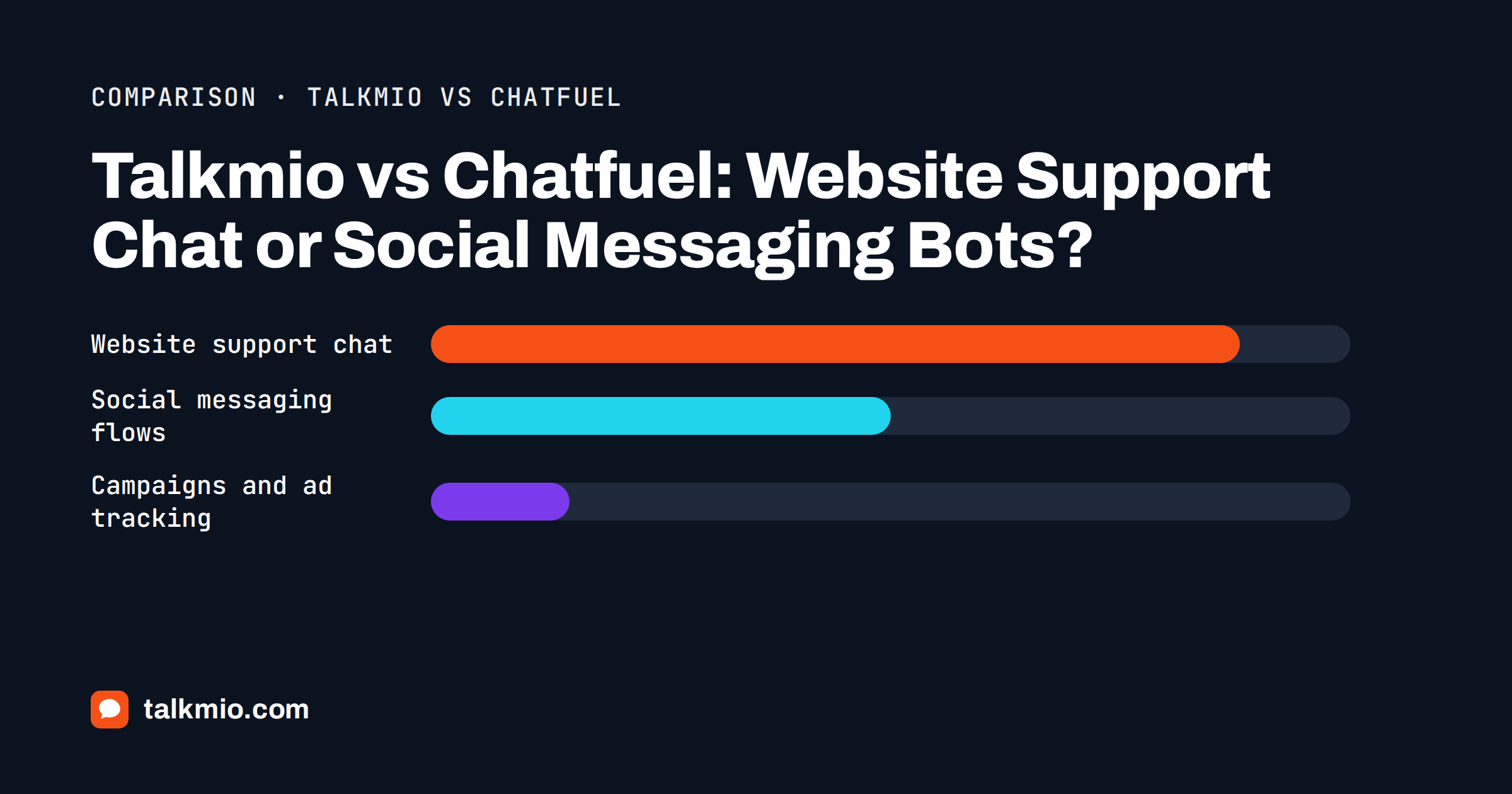
Talkmio vs Chatfuel is a comparison between two products that both use AI to answer customers but start from opposite places. Chatfuel describes itself as an AI chatbot platform for WhatsApp, Instagram and Facebook, built around messaging channels, campaigns and sales automation. Talkmio is an AI live chat for websites, built around support conversations, tickets and an Inbox for your team. If you are choosing between them, the useful question is not which is better, but where your customers actually talk to you and what you need to happen after they do.
The facts about Chatfuel below come from its public pricing and product pages at the time of writing. Plans change, so check both vendors’ pages before you decide. Talkmio’s details come from its live pricing page, documentation and FAQ.
Talkmio vs Chatfuel at a Glance
The table summarises the main differences. Each row is explained in more detail in the sections that follow.
| Area | Talkmio | Chatfuel |
|---|---|---|
| Main purpose | AI live chat and support Inbox for websites | AI chatbots for WhatsApp, Instagram and Facebook |
| Where it starts | One script on your website | Connecting your messaging accounts |
| How answers are made | Mio answers only from your site, FAQ and documents | AI agent plus flows and templates built in the platform |
| Strong points | Support, tickets, e-mail channel, live visitors, reports | Sales flows, campaigns, ad tracking, WhatsApp automation |
| Free option | Free plan: 1 operator, 1 website, 50 AI answers a month | Free trial, no card required |
| Pricing style | Tiers by seats, websites and AI answers | A Business plan, listed at US$18 a month billed yearly, plus an Agency tier |
| Messaging channels | Messenger, Instagram, WhatsApp on Ultimate | Core of the product |
| Data location | EU servers (Germany) | Not stated on the pricing page |
If you read only one line: Chatfuel is the stronger choice when WhatsApp and social messaging are your main sales and marketing channel, and Talkmio is the stronger choice when your website is where customers ask for help.
What Each Product Is Built For
Chatfuel’s public pages describe automation on WhatsApp, Instagram and Facebook: AI-powered chatbots, a shared team inbox, a CRM, integrations with tools such as Google Sheets and Zapier, and access to the official WhatsApp API. Its feature list leans towards marketing and sales: tracking ad campaigns and funnels, qualifying and scoring leads, selling products in the chat, replying to comments and sending bulk WhatsApp campaigns. In that world, a chatbot is often a sales assistant that starts and guides conversations.
Talkmio is built around the reverse flow. A visitor lands on your website and asks a question. Mio reads your website, FAQ and uploaded documents and answers only from that content, and it hands the chat to a person when it cannot answer, when the visitor asks for one, complains or asks about an order. Behind that sits an Inbox with filters, assignment, priority, status and internal notes, numbered tickets, an e-mail channel, live visitors, contacts and reports. It is a support tool first, and it does not try to be a campaign engine.
Setup and Day-to-Day Work
Setting up Talkmio takes about ten minutes. You create an account, add your website, paste one snippet before the closing body tag or install the WordPress plugin with a site key, and teach Mio by adding your site as a source. Then you test answers with Try Mio and go live. The work afterwards is content: when a policy changes, you update the page and re-read the source.
Chatfuel’s work is different. You connect channels, build or adapt flows and templates, decide when the AI agent speaks and set up campaigns and integrations. That gives more control over sales journeys, but it needs more design time, and the quality of the result depends on the flows you build. Teams with a marketing person who enjoys that work may prefer it; teams with a support person who wants answers to come from existing pages may not.
Where Chatfuel Is Genuinely Stronger
An honest comparison names the other side’s strengths. Chatfuel is stronger in several areas:
- WhatsApp marketing. Bulk campaigns, follow-ups and official API access are central to its product. Talkmio can answer WhatsApp messages in the Inbox, but it does not offer campaign tools.
- Ad and funnel tracking. It lists sending WhatsApp conversions to Meta Pixel and seeing which ad campaigns drive sales. Talkmio has no such feature.
- Selling in chat. Booking meetings, taking orders and sending payment links are part of its messaging flows.
- Agencies. An Agency tier lets one team manage several client businesses.
- Social comment replies. It can reply to comments on posts and Reels automatically.
If those are your core needs, Talkmio is not a replacement, and we would rather say so than let you find out later.
Where Talkmio Fits Better
Talkmio fits better when the centre of gravity is your website and your support team. Visitors on the site get an answer from your own content in their own language, and Mio replies in the language the visitor writes in, including Lithuanian, English, German, Polish, Russian, Spanish, French and 30+ others. Your team sees live visitors with country, page, device and source, and can start a chat. Every conversation can become a numbered ticket, and on Pro and Ultimate plans a Talkmio e-mail address turns forwarded support mail into tickets, with replies going back in the same thread.
It also suits teams that care where data lives. Talkmio stores data on servers in the EU (Germany), and only the conversation text and relevant knowledge base excerpts go to the AI model provider. You can export or delete data at any time. Our guide to how to choose live chat software lists the questions to ask any vendor on this topic.
Pricing Compared Fairly
Pricing models differ, so a simple price comparison can mislead. Chatfuel’s pricing page lists a Business plan at US$18 a month when billed yearly (US$216 a year), with US$20 of AI credits a month, and an Agency tier from US$90 a month billed yearly. It also notes that Meta charges for WhatsApp messages separately, with the fees paid from the same wallet as the plan’s credits. Those costs depend on how many messages you send, so estimate your volume before comparing.
Talkmio lists Free at €0 with 1 operator, 1 website and 50 AI answers a month; Pro at €19 a month (or €190 a year) with 3 operators, 3 websites, 1000 AI answers and the e-mail channel; and Ultimate at €49 a month (or €490 a year) with 10 operators, 10 websites, 5000 AI answers, Facebook, Instagram and WhatsApp channels, reports export and API access. Larger Enterprise tiers exist above that. Prices are in euro, VAT 21% is added at checkout and you can pay with PayPal or bank transfer. The Free plan needs no card, and paid plans start with a 14-day trial. Always check the live pages, because both vendors change plans.
Using WhatsApp and Instagram With Talkmio
You do not have to choose one world completely. On Ultimate, Talkmio can connect a Facebook Page and the Instagram business account attached to it, and WhatsApp Business with a phone number ID and a permanent token. Messages arrive in the Inbox, Mio answers them like website chats and your replies go back to the same channel. Our guides to connecting WhatsApp Business to chat and WhatsApp and Instagram live chat explain how this works.
The key difference is intent. In Talkmio those channels are another place where customers ask questions, and the Inbox is where your team answers. In Chatfuel they are the place where automated sales and marketing flows run. If you need both, you may end up using a messaging platform for campaigns and Talkmio for the website and the support desk.
Questions to Ask Before You Commit
Whichever product you lean towards, put the same questions to both vendors, and read the current Chatfuel pricing page and Talkmio’s pricing page side by side on the day you decide.
- How many conversations will start on each channel in a normal month, and how many of them are repeat questions that content can answer?
- Who will build and maintain the automation or the knowledge base, and how much time per week can they give?
- What exactly happens when the AI cannot answer: does the conversation reach a person with the full history, and how is the team notified?
- What extra costs apply, such as channel fees, extra seats, extra websites or usage above the included credits?
- Where is customer data stored, and how do you export or delete it?
Write the answers down for both products. The comparison often becomes obvious once the real volume and the real maintenance effort are on paper.
Which Should You Choose?
Use this simple test. Where do most of your customer conversations start? If they start in WhatsApp or Instagram, often from ads, and you want to automate sales and follow-ups, Chatfuel is built for that. If they start on your website, and you want an assistant that answers from your own pages plus an Inbox, tickets and reports for your support team, Talkmio is built for that.
Then check three practical points: who will maintain the flows or the content, what your monthly message volume looks like and where your data must be stored. A short trial of each, using the same ten real customer questions, will tell you more than any comparison page, including this one, and a week of real conversations will show which interface your team actually enjoys using. For a similar comparison with a different type of competitor, see our article on Talkmio vs Tidio.
Frequently Asked Questions
Is Talkmio a Chatfuel alternative?
Only partly. Both use AI to answer customers, but Chatfuel focuses on WhatsApp, Instagram and Facebook automation, with campaigns and sales flows. Talkmio focuses on website support chat with an Inbox, tickets and reports. If your customers mostly start on your website, Talkmio fits; for messaging-led sales, Chatfuel does.
Can Talkmio handle WhatsApp and Instagram messages?
Yes, on the Ultimate plan. You connect a Facebook Page and the Instagram business account attached to it, plus WhatsApp Business with a phone number ID and a permanent token. Messages arrive in the Inbox, Mio answers them like website chats, and your replies go back to the same channel.
Does Talkmio send WhatsApp marketing campaigns?
No. Talkmio answers customer messages and supports them through the Inbox, but it does not offer bulk campaigns or ad conversion tracking. If bulk WhatsApp campaigns and Meta Pixel events are central to your business, a platform built for messaging marketing, such as Chatfuel, is the better fit.
How do the prices compare?
Chatfuel lists a Business plan at US$18 a month billed yearly, plus Meta’s WhatsApp fees, and an Agency tier. Talkmio has a Free plan, Pro at €19 a month and Ultimate at €49 a month, with VAT added at checkout. The models differ, so compare against your own message and seat counts.
Where is my data stored with Talkmio?
On Talkmio’s servers in the EU (Germany). Only the conversation text and relevant knowledge base excerpts go to the AI model provider, and you can export or delete your data at any time by writing to support. Check any vendor’s own statements for where its data is held.
Can I try Talkmio before paying?
Yes. The Free plan includes 1 operator, 1 website and 50 AI answers a month, needs no card and has no time limit. Paid plans, Pro and Ultimate, start with a 14-day trial. Add your website as a source, then test real customer questions with Try Mio before going live.
The Bottom Line
Talkmio vs Chatfuel comes down to where your customers talk and what you need next. Chatfuel is built for WhatsApp, Instagram and Facebook sales automation and campaigns. Talkmio is built for website support, with answers from your own content, a shared Inbox, tickets and EU data storage. Test both with the same real questions. Create a free Talkmio account and see how Mio answers yours.