
 Lietuviškai
 Deutsch
 Français
 Русский
 Español
 Polski
 Italiano
 Українська
 Čeština
 Português
 日本語
 Latviešu valoda
 Eesti
 Magyar
 Bahasa Indonesia
 Türkçe
 हिन्दी
 Ελληνικά
 العربية
 ไทย
 Tiếng Việt
 Română
 Bahasa Melayu
 বাংলা
Live chat for the Peruvian market is a project for sellers who want to treat Peru as more than a line in a drop-down menu. Peru is a large Spanish-speaking country with a growing online population, a strong habit of paying by mobile wallet or on delivery, a capital that behaves like its own market and regions that behave very differently. Visitors expect to read prices in soles, to understand what tax is included and to know how and when a parcel will arrive in Lima, Arequipa, Cusco or a smaller town. This guide covers what Peruvian visitors ask, how to prepare your content and how to set up a chat that feels local without pretending to be.
Talkmio is an AI live chat for websites. Its assistant, Mio, reads your website, FAQ and uploaded documents and answers only from that content, in the language the visitor writes in. It hands the conversation to your team when it cannot answer. That suits this market, because the hard part is not the technology but the facts you must state clearly: delivery, payment, tax and returns. Check every detail against official sources, because rates and rules change.
Spanish for Peru: Small Differences That Matter
The official language of Peru is Spanish, and in some regions Quechua, Aymara and other indigenous languages are co-official, as the overview of languages of Peru explains. For a website chat, Spanish is the language that matters, and written Peruvian Spanish is close to the Spanish of other Latin American countries, with local words and habits.
Mio replies in the language the visitor writes in, including Spanish, and the chat window is translated into Spanish as well. Questions in one language can be answered from pages in another, so a visitor who writes in Spanish can get an answer from an English page. The best answers still come from content in the visitor’s own language, especially for delivery, payment and return pages. If your website is written for Spain, check it for terms that sound foreign in Peru: words for a mobile phone, a parcel, a discount or a bank card can differ from country to country. Our guides to the Spanish market and the Mexican market cover the language side in more detail.
Tone and formality
Peruvian customers usually appreciate a polite, warm tone. Using usted with new customers is safe, and a friendly greeting before the answer is normal. Write this into your business instructions, which tell Mio what you sell, the tone to use and what it must never promise, and check the first answers with a native speaker. Use Try Mio, which shows the answer, which knowledge pieces were used and how long it took, to test ten typical questions before launch.
What Peruvian Visitors Ask
Look at your own data first. Group the questions that arrive from Peru and write one page for each group. The same themes tend to appear.
- Do you ship to Peru? At what cost, with which carrier, and how long does it take to Lima and to other regions?
- Are there import charges? Customs and taxes on parcels from abroad are a top worry.
- Which currency do you charge in? Prices in soles are reassuring, and a surprise conversion is not.
- Can I pay on delivery, by bank transfer or with a mobile wallet? Payment preference is strong.
- Do you issue a factura or a boleta? Businesses need an invoice with their tax number.
- What happens if I return it? Who pays the postage, and how long do I have?
- Is there a local address or phone number? A local contact builds trust.
Write the answers in plain language and keep the figures current. A chat that quotes an old delivery price creates a dispute, and a chat that says “please wait for the team” creates a ticket. Mio answers only from your content, so what you write is what the visitor hears.
Soles, IGV and Prices
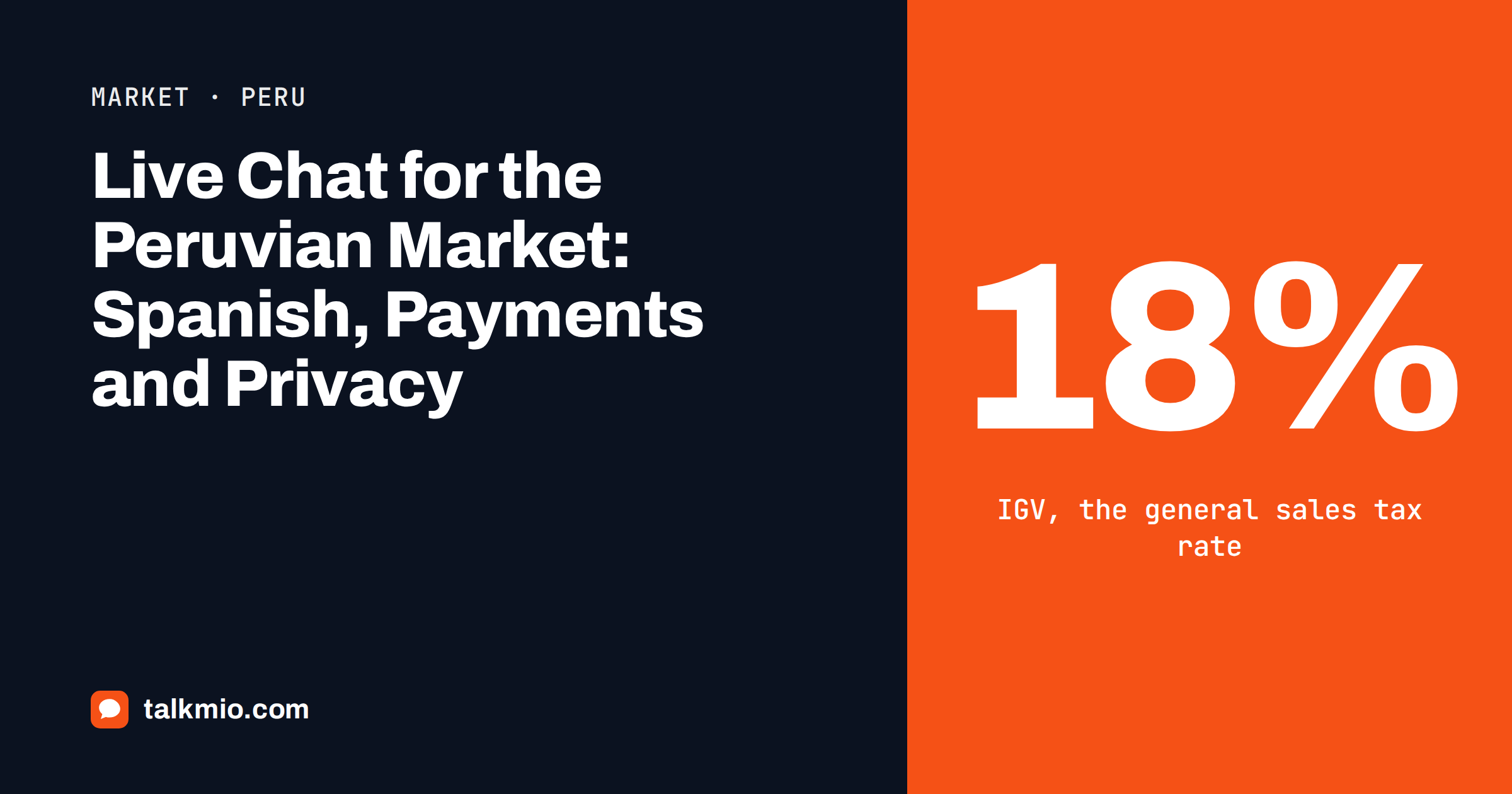
Peru uses the sol, with the code PEN. Showing prices in soles is the simplest way to build trust, and it avoids a conversion at the end of checkout. The general sales tax is the IGV, and the overview of value-added tax by country lists a rate of 18 percent, made up of 16 percent IGV and 2 percent municipal promotion tax, at the time of writing. Rules for selling goods and services from abroad to Peruvian customers depend on your location and what you sell, so confirm yours with an accountant before you write the page.
The chat should do one thing: repeat what your checkout does. If prices include IGV, say so. If a business buyer needs an invoice with a tax number, explain the steps. Do not let Mio calculate tax or promise an invoice format you have not confirmed. Write the rule once, and let the chat quote it. A person should answer unusual cases.
Payments Peruvian Customers Expect
Payment habits in Peru differ from those in much of Europe. Cards are common, but cash and mobile wallets are also very important, and many shoppers prefer to pay on delivery. The table lists the usual options and what a chat should be ready to explain. Confirm which ones you support, and do not let Mio guess.
| Payment method | What visitors ask | What to write on your page |
|---|---|---|
| Credit and debit cards | Are foreign cards accepted, is the payment in soles? | Accepted card types, currency and any extra bank fees you know of |
| Mobile wallets such as Yape or Plin | Can I pay with my phone? | Yes or no, and how it works if yes |
| Bank transfer | Which account, how long until the order is released? | The steps and the usual confirmation time |
| Cash on delivery | Can I pay when the parcel arrives? | Yes or no, the areas where it is available and any fee |
| Instalments | Can I split the payment? | Whether you offer it, and the terms |
Never ask visitors to type card numbers into the chat. Our guide to live chat and PCI compliance explains why payment details do not belong in a conversation.
Delivery in a Country of Very Different Regions
Peru has a coast, the Andes and the Amazon, and delivery times differ greatly between Lima, the larger coastal cities and remote areas. Do not promise one time for the whole country. Publish a table by region with the carrier, the usual time range and the cost, and tell Mio to quote it. If a visitor lives in a place that is not on the list, Mio should not guess. Instruct it to say that the area is not on the published list and to hand the visitor to your team. A rule such as “never confirm delivery to a place that is not on the delivery page” is clear and testable.
Explain what happens when no one is home, whether the carrier calls first and where the visitor can collect a parcel, if you offer collection points. For the unhappy cases, such as a delayed parcel, have the chat hand over quickly. Our guide to where-is-my-order chats shows how to handle them politely.
Privacy and Data Protection in Peru
Peru has a personal data protection law, Law No. 29733, and a data protection authority, the Autoridad Nacional de Protección de Datos Personales, which publishes information on its page at gob.pe. A chat widget processes personal data: the text a visitor writes, an e-mail address if they leave one and technical details such as country and device. Be clear about it in your privacy policy, collect only what you need and keep the chat consistent with the policy. If you are based in the European Union, your own data protection duties apply as well. Our guide to GDPR and live chat covers the basics.
Talkmio stores data on servers in the EU (Germany). Only the conversation text and relevant knowledge base excerpts are sent to the AI model provider, and you can export or delete your data at any time by writing to [email protected]. If you use a pre-chat form, make the e-mail field optional unless you really need it. Ask a local adviser to confirm what the law requires for your business before you publish the privacy page.
Time Zone and Staffing
Peru is five hours behind UTC all year and does not change its clocks, so the gap to Europe changes with the seasons. For a team in Europe, Peruvian evenings are European nights, and Peruvian mornings arrive in the European afternoon. Decide whether you answer in person during Peruvian hours, or whether Mio handles the first answer and your team replies the next working morning. Set business hours under Websites to match reality, write an honest offline text and use the Inbox filters Unassigned and Unanswered at the start of the day. When your whole team is offline, the visitor is asked for an e-mail before the first message, and your later reply from the Inbox goes out as an e-mail. If nobody is online, you also receive an e-mail and a push notification on the mobile app for iOS and Android.
Setting Up Live Chat for the Peruvian Market
Create a free account at app.talkmio.com, add your website, paste the snippet before the closing body tag or install the WordPress plugin, and open Mio AI, then Knowledge base. Add your website, and then add the pages you wrote for this market. You can upload files in PDF, DOCX, TXT, MD, CSV or HTML, up to 15 MB each. Then write business instructions, for example “never quote delivery dates for Peru; show the published range and hand order questions to the team”. Under Websites, set the widget language to auto-detect, write the welcome and offline texts in Spanish and check the position on a phone, where many Peruvian visitors browse. After launch, read the first week of conversations in the Inbox and turn every repeated question into a new page. Reports show conversations per day, the share Mio answered alone, hand-offs and busiest hours, so you can see whether Peruvian traffic justifies a person on shift in local hours.
Frequently Asked Questions
Does Mio speak Peruvian Spanish?
Mio replies in the language the visitor writes in, including Spanish, and the chat window is translated into Spanish. Local words and habits depend on your content, so write your pages for Peruvian customers and test ten real questions with Try Mio before launch, ideally with a native speaker.
Which currency should the chat quote?
The one your checkout uses. Peru uses the sol, and prices in soles are the most reassuring for visitors. Write the rule on a page, say whether prices include IGV and let Mio repeat it. Do not let the chat calculate taxes or promise invoice formats you have not confirmed.
Can the chat explain mobile wallets and cash on delivery?
Yes, if you publish what you support. Mio answers from your website, FAQ and uploaded documents, so write a page that lists each payment method, the areas where it is available and any fee. If you do not offer a method, say so plainly, and never ask visitors to type card numbers into the chat.
How should the chat handle delivery to remote regions?
Publish a table by region with carrier, time range and cost, and instruct Mio never to confirm delivery to a place that is not on the page. Visitors from other places are handed to your team, who can decide whether to make an exception and answer from the Inbox.
Where is the chat data stored?
On Talkmio servers in the EU (Germany). Only the conversation text and relevant knowledge base excerpts are sent to the AI model provider, and you can export or delete your data any time by writing to [email protected]. State this in your own privacy policy, and confirm local requirements with an adviser.
Can I try it for free?
Yes. The Free plan includes one operator, one website, 50 AI answers a month, 50 tickets a month and 20 knowledge base pages, with no card needed. Paid plans add operators, websites, AI answers and the e-mail channel. See the pricing page for the current figures.
The Bottom Line
Live chat for the Peruvian market works when you respect four facts: visitors expect Spanish that sounds local, prices in soles with tax stated clearly, payment methods that include wallets and cash, and delivery that depends on the region. Write short pages for each topic, test Mio in Spanish with a native speaker and keep your privacy information honest. Start free with Talkmio, add your website and see how many Peruvian questions Mio can answer on its own.