
 Lietuviškai
 Deutsch
 Français
 Русский
 Español
 Polski
 Italiano
 Українська
 Čeština
 Português
 日本語
日本語 Latviešu valoda
 Eesti
Eesti Magyar
 Bahasa Indonesia
 Türkçe
 हिन्दी
 Ελληνικά
 العربية
 ไทย
ไทย Tiếng Việt
 Română
 Bahasa Melayu
 বাংলা
বাংলা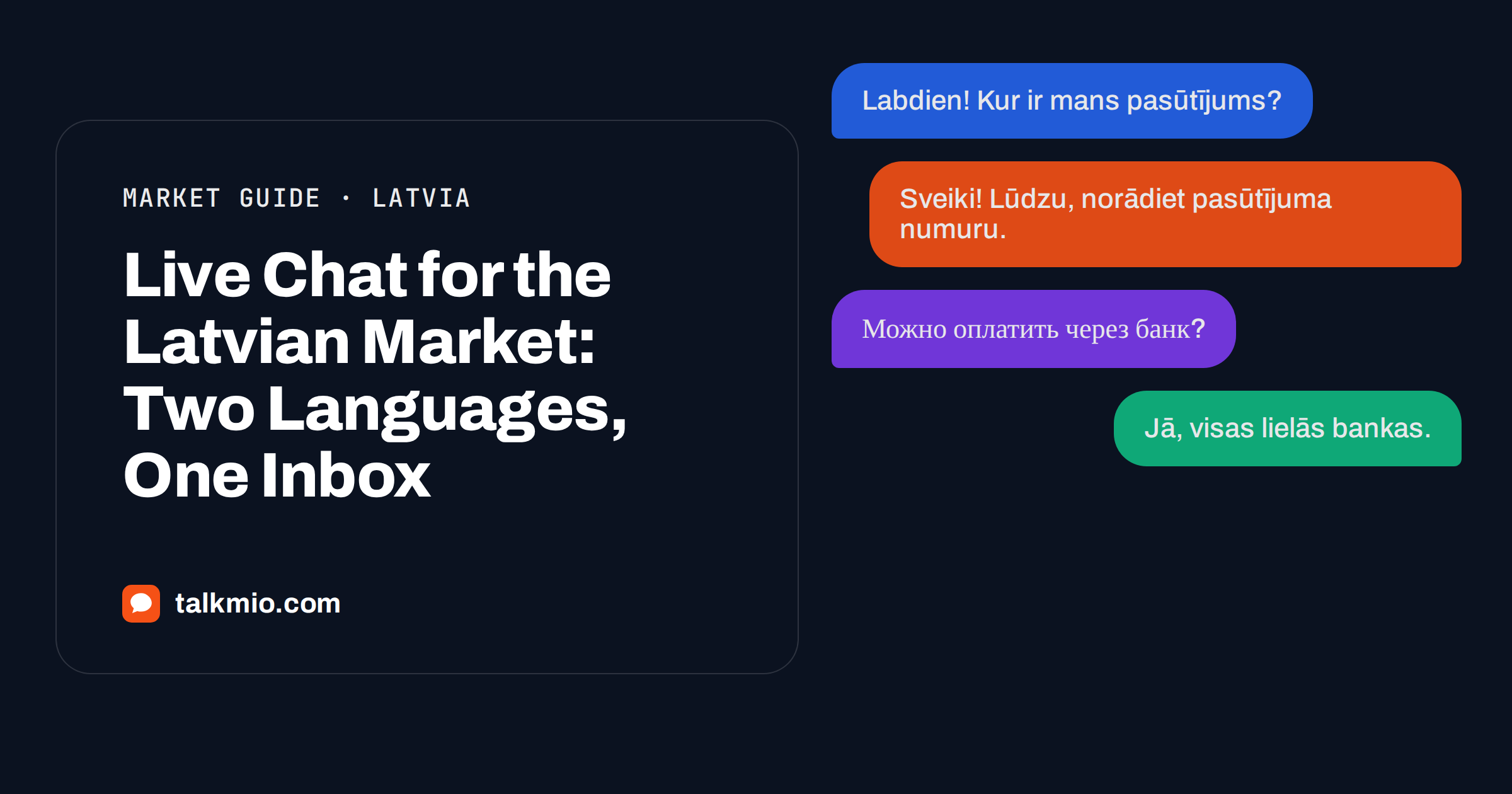
Setting up live chat for the Latvian market comes down to one fact most foreign sellers underestimate: many customers switch between Latvian and Russian, and plenty of younger buyers are just as happy in English. A chat that answers in Latvian first, follows the customer’s language without comment and knows the local delivery and payment habits will feel native. One that greets everyone in English and routes Russian messages to a queue nobody watches will not. This guide covers the language question, tone, the delivery and payment questions that dominate Latvian chats, staffing around local holidays and how to run Latvia from the same inbox as Lithuania and Estonia.
Why Latvia Is a Two-Language Chat Market
Latvia is a small country of under two million people, with Riga as the dominant commercial centre. Latvian is the only official language, but Russian is widely spoken, especially in Riga and in the eastern region of Latgale. Wikipedia’s overview of the languages of Latvia gives the historical background.
For a support team this means three things:
- Your default must be Latvian. It is the language of the state, of most business correspondence and of a growing share of everyday life.
- A noticeable part of your chats will arrive in Russian, and those customers expect to be understood without being asked to switch.
- Many customers, particularly under 35, write in English when the site looks international.
The practical rule is simple: reply in the language the customer writes in, and never make a point of it. Language is a sensitive subject in Latvia; your chat is not the place for opinions about it.
Latvian First: What It Means for Your Widget
Latvia’s State Language Law requires that information for consumers is available in Latvian. Other languages can be offered alongside, but not instead. For a chat widget, the safe approach is:
- widget interface, greeting and offline form in Latvian on the Latvian version of your site;
- automatic language detection so a Russian or English message gets a reply in that language;
- your Latvian-language pages as the primary source for answers, so policy wording matches what is legally published.
If you only have an English website, translate at least the terms, delivery, returns and privacy pages before you actively sell into Latvia. A chat assistant can answer in Latvian from English pages, but the pages themselves should exist in Latvian too.
Choosing a Language Setup
Most stores selling into Latvia pick one of three setups. The table shows the trade-offs.
| Setup | Who it suits | Strength | Weakness |
|---|---|---|---|
| Latvian only | Local services with a Latvian-speaking audience | Simple, fully compliant, one set of pages | Russian and English speakers feel less welcome |
| Latvian + Russian | Retail and services in Riga and Latgale | Covers most residents in their preferred language | Two sets of content to keep in sync |
| Latvian + Russian + English | E-commerce, tourism, SaaS, Baltic-wide shops | Covers residents, expats and visitors | More pages to maintain; staff need tools to reply in all three |
| English only | Nobody selling to Latvian consumers | — | Fails the Latvian-language expectation |
An AI assistant makes the three-language setup much cheaper, because it answers in the customer’s language from a single knowledge base. Talkmio’s Mio replies in more than 30 languages, including Latvian and Russian, and can find an answer written in Latvian when the question arrives in Russian. For the wider picture, see our guide to multilingual live chat without hiring native speakers.
Tone: Jūs, Names and Short Replies
Use the formal form
In Latvian customer service, address customers with the formal Jūs, not the informal tu. In written correspondence Jūs is often capitalised as a courtesy. In Russian, the equivalent is Вы. Young brands sometimes use tu in marketing, but for support questions about money or delivery, formal is safer.
Greetings that sound local
Labdien! (“Good day”) works at any time. Sveiki! is friendlier and still polite. Avoid long, enthusiastic openers; Latvian customers generally prefer a short, direct answer to a warm paragraph. A good greeting is one line: Labdien! Kā varam palīdzēt?
Names
Latvian surnames change form by gender and grammatical case. If you address someone by name, use the name exactly as they wrote it rather than guessing an inflected form. First names are fine in chat once the customer has introduced themselves.
Diacritics and Messages Typed Without Them
Latvian uses long vowels and several special consonants: ā, č, ē, ģ, ī, ķ, ļ, ņ, š, ū, ž. On phones, many people skip them and type “paldies” correctly but “pasutijums” instead of “pasūtījums” (order), or write in a mix of Latin letters for Russian words.
Two consequences for your chat:
- Your system must understand messages without diacritics. Test a few before launch.
- Your replies should always use correct spelling. A reply without diacritics looks careless in writing, even if customers type that way themselves.
Also check that your widget font renders every Latvian character. Some decorative fonts drop ķ or ļ and fall back to a different typeface mid-word.
Delivery Questions: Pakomāts, Couriers and Timing
A large share of e-commerce chats in Latvia are about delivery, and most of them mention a pakomāts, the parcel locker. Parcel lockers are the default choice for many online shoppers across the Baltics. Networks run by Omniva, DPD, Latvijas Pasts and others cover towns across the country; Omniva’s Latvian site shows how locker delivery is presented to customers.
Questions you should answer on your delivery page, so your chat can answer them too:
- Which locker networks you ship to, and whether the customer chooses a specific locker at checkout.
- How long delivery takes to Riga and to the regions.
- How long a parcel waits in the locker before it is returned.
- Whether courier delivery to the door is available, and at what cost.
- How returns work through a locker.
Questions about a specific parcel (“where is my order?”) need the order number and a person with access to your shop system, so hand them over rather than letting an assistant guess.
Payment and Bank-Link Questions
Latvian shoppers commonly pay by card, by bank link through their own bank’s internet banking, or through mobile wallets. Businesses also frequently ask for an invoice with company details for bank transfer, so B2B sites should explain how to get a proforma or a VAT invoice.
Frequent chat questions:
- “Can I pay through my bank?” Say which banks your payment provider supports.
- “Can I get an invoice for my company?” Explain which details you need: company name, registration number and VAT number if applicable.
- “The payment went through but I have no confirmation.” A person should check this; never ask for card numbers in chat.
Prices in Latvia are in euros, and consumer prices include VAT, currently 21% at the standard rate. If your site shows prices without VAT to business customers, say so clearly; misunderstandings about VAT generate avoidable chats.
Consumer Rights Questions
Latvian consumers have the EU-wide 14-day right of withdrawal for most online purchases, described in the Consumer Rights Directive. The national enforcement body is the Consumer Rights Protection Centre, PTAC, whose English site explains its role.
In chat, this shows up as questions about returns, refunds and faulty goods. Two rules help:
- Publish your return process in Latvian, clearly, with the 14 days and any exceptions. The assistant can then quote it accurately.
- Hand every complaint to a person. Mio does this automatically when a visitor complains, which is exactly the moment a careful human reply matters most.
Staffing Around Latvian Time and Holidays
Latvia uses Eastern European Time, one hour ahead of Central Europe. If your team sits in Berlin or Warsaw, your 9:00 is already 10:00 in Riga, and the evening peak after work arrives an hour earlier than you expect.
Plan for these dates:
- Līgo and Jāņi (23–24 June). The midsummer holiday is the biggest celebration of the year. Many people are away for several days; chat volume drops sharply, then returns with delayed delivery questions.
- 4 May, Restoration of Independence Day, and 18 November, Proclamation Day, are public holidays; if they fall on a weekend, a weekday off may follow.
- December brings the usual pre-Christmas delivery rush, with locker deadlines as the main question.
Set business hours in your widget so visitors outside them are asked for an e-mail address instead of waiting. In Talkmio, when the team is offline the reply goes out by e-mail, so no conversation is lost over a long weekend.
Running Latvia, Lithuania and Estonia From One Inbox
Many shops serve all three Baltic states from one website with three language versions. The markets share parcel-locker habits and the euro, but not the language: Latvian, Lithuanian and Estonian are not mutually understandable, and Russian is a common second language in all three.
A single inbox with an assistant that answers in each customer’s language is usually the most efficient setup. Keep one delivery page per country, because delivery times and locker networks differ. Our guide to live chat for the Lithuanian market covers the neighbouring market, and the Russian-speaking market guide covers tone for Russian-language chats.
Setting Up Live Chat for the Latvian Market With Talkmio
- Install the widget on every language version of the site with one snippet or the WordPress plugin.
- Set the widget language to auto-detect, so the interface follows each visitor’s language instead of a fixed one.
- Add your Latvian pages to the knowledge base first, then Russian and English versions.
- Write business instructions: formal address, never promise delivery dates, hand parcel and payment problems to the team.
- Test with real Latvian and Russian questions, including some typed without diacritics.
- Set business hours in Latvian time.
The Free plan covers one website and 50 AI answers a month, enough for a trial. Paid plans in euros are listed on the Talkmio pricing page.
Frequently Asked Questions
Which language should my chat use for Latvian customers?
Start in Latvian on the Latvian version of your site and reply in whatever language the customer writes in. That usually means Latvian, Russian or English. Automatic language detection handles this without asking the customer to choose, which avoids an awkward question at the start of the chat.
Is it legal to offer customer support in Russian in Latvia?
Businesses may offer additional languages, including Russian and English, alongside Latvian. What the law requires is that consumer information is available in Latvian. Keep your terms, delivery and returns pages in Latvian, and treat other languages as an extra service for customers who prefer them.
Should I use Jūs or tu in Latvian chat replies?
Use the formal Jūs for customer support. It is the expected form for questions about orders, payments and complaints. Some youthful brands use tu in marketing, but a formal reply is never wrong in a support conversation, while an informal one can feel disrespectful to older customers.
What do Latvian customers ask most in e-commerce chats?
Delivery questions dominate: which parcel locker networks you use, delivery times to Riga and the regions, and how long a parcel waits in the locker. After that come payment by bank link, company invoices, returns within 14 days and the status of specific orders.
Can an AI assistant answer in Latvian if my website is in English?
Yes. Mio can answer a Latvian question from English content and reply in Latvian. You should still publish your key policy pages in Latvian, both for customers and because Latvian-language consumer information is expected. The assistant will then quote your own Latvian wording.
Can one chat serve Latvia, Lithuania and Estonia?
Yes. One widget and one inbox can serve all three markets if the assistant replies in each visitor’s language. Keep separate delivery pages for each country, since carriers and delivery times differ, so answers about shipping stay accurate for every market.
The Bottom Line
Live chat for the Latvian market works when it is Latvian by default, answers Russian and English speakers without friction and knows the parcel-locker, bank-link and 14-day return questions by heart. Keep replies formal and short, spell Latvian correctly and hand parcel, payment and complaint cases to a person. Plan staffing around Latvian time and the Jāņi holiday. Talkmio handles the language switching and the handoff in one inbox; start free at app.talkmio.com.