
 Lietuviškai
 Deutsch
 Français
 Русский
 Español
 Polski
 Italiano
 Українська
 Čeština
 Português
 日本語
日本語 Latviešu valoda
 Eesti
Eesti Magyar
 Bahasa Indonesia
 Türkçe
 हिन्दी
 Ελληνικά
 العربية
 ไทย
ไทย Tiếng Việt
 Română
 Bahasa Melayu
 বাংলা
বাংলা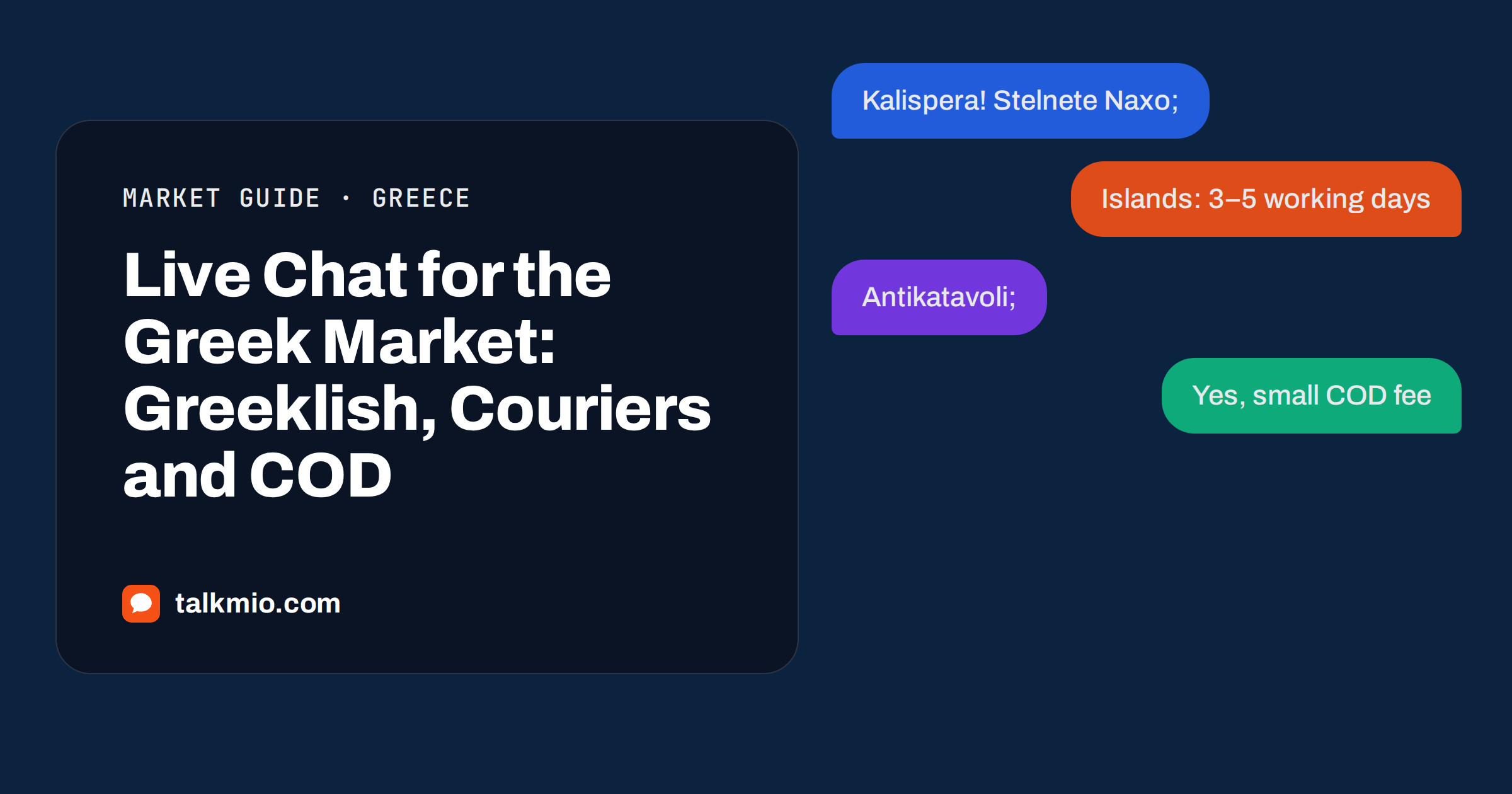
Greek shoppers ask detailed questions before they buy, often in a mix of Greek script and Latin letters, and they compare shops carefully on price, delivery to the islands, instalments and cash on delivery. Live chat for the Greek market works when it understands those habits, and feels like a foreign shop when it does not.
This guide covers how Greek customers write in chat, the formal and informal “you”, the delivery, payment and invoice questions you will receive, what to prepare in your knowledge base, and how a small team without Greek speakers can still give good support.
How Greek Customers Write in Chat
Greek uses its own alphabet, and that alone affects your widget, your forms and your test plan. But the bigger surprise for many foreign shops is how often customers do not use it in chat.
Greeklish
Greeklish is Greek written with Latin letters, for example kalispera, thelo na rotiso gia tin paraggelia mou (“good evening, I want to ask about my order”). It grew up in the days of phones and computers without Greek keyboards and is still common in informal messages. Spelling is not standardised: the same word may appear with th or 8, i or h, depending on the writer.
What this means for chat:
- Test your assistant with Greeklish, not only with Greek script. Ask your three most common questions both ways and compare the answers.
- Reply in Greek script unless the customer clearly prefers otherwise. Greeklish is something people type, not something they expect a company to write back.
- Do not treat Greeklish as low quality. It is a habit, not a sign of a careless customer.
Accents and the Greek question mark
Greek marks stress with an accent (the tonos), but many people drop accents when typing quickly, and capitals are normally written without them. Your search and matching should not depend on accents being present.
One detail catches out almost every foreign support team: the Greek question mark is the semicolon. Πότε θα έρθει η παραγγελία μου; means “When will my order arrive?”. An agent reading through a translation tool may never notice, but anyone building rules or reports on question marks should.
Εσείς or Εσύ: Tone in Live Chat for the Greek Market
Greek has a polite plural form, εσείς, used with strangers and in formal contexts, and an informal εσύ for friends and family. Customer service has traditionally used εσείς.
- Use εσείς for banking, insurance, healthcare, B2B, government-related services and older audiences. It is also the safe default if you are unsure.
- Informal εσύ appears in youth fashion, gaming and lifestyle brands whose whole website speaks that way.
- Match your website. Switching form between the site and the chat feels like talking to a different company.
Greek conversations also tend to open with a greeting appropriate to the time of day: καλημέρα (good morning) or καλησπέρα (good evening). An assistant that answers a “καλησπέρα” with a flat answer and no greeting reads as cold. In Talkmio, you can say this in Mio’s business instructions: “In Greek, use the polite εσείς form and greet the customer before answering.” Mio replies in the language the visitor writes in, so the instruction applies only to Greek conversations.
Delivery Questions: Couriers, Lockers and the Islands
Delivery is the topic Greek shoppers ask about most, and geography is the reason. Greece has a long mainland, many inhabited islands and mountain villages, and delivery times and costs vary a lot between them.
Islands and remote areas
Expect questions like:
- “Do you deliver to Naxos? How long does it take?”
- “Is there an extra charge for the islands?”
- “Can it arrive before the ferry schedule changes in winter?”
Couriers commonly apply longer times and sometimes surcharges for islands and areas they classify as hard to reach. If your shipping page only says “2 to 4 working days”, Greek customers will ask whether that includes Crete or Rhodes. State island delivery times and any extra cost clearly, so your assistant can quote them.
Couriers and lockers
Customers often name the courier they prefer. Major networks include ACS, ELTA Courier, Geniki Taxydromiki and Speedex, and parcel lockers such as BOX NOW have become a popular alternative to home delivery in cities. Customers ask which networks you use, whether a locker near them is available, and whether they can collect from a courier branch instead.
Order tracking
Questions about a specific parcel need order data. Talkmio hands the conversation to your team when a visitor asks about a specific order. Our guide on cutting where-is-my-order chats shows how better tracking e-mails reduce those questions in the first place.
Payments: Cash on Delivery, Instalments and Bank Apps
Αντικαταβολή: cash on delivery
Cash on delivery, antikatavoli, has long been a mainstream payment option in Greek e-commerce, especially for first purchases from an unfamiliar shop. Many shops charge a small fee for it. Customers ask whether it is available, what it costs, and whether the courier accepts cards at the door. Put the answers on your payment page.
Interest-free instalments
Paying by card in instalments, δόσεις, often interest-free, is a common feature of Greek online shops for larger purchases. If you offer it, customers will ask how many instalments apply above which order value and which cards are eligible. If you do not offer it, say so clearly instead of letting the chat leave the question unanswered. Many Greek shoppers will compare that answer with your competitors’.
Bank app payments
Payments through banking apps and instant payment services are increasingly common. If you accept them, describe exactly how the payment works and when the order is confirmed.
Receipts, Invoices and VAT
At Greek checkouts, customers typically choose between a retail receipt (απόδειξη) and a business invoice (τιμολόγιο). Business buyers need their company details and tax number (ΑΦΜ) on the invoice, and they notice mistakes.
Common chat questions:
- “Can I get a τιμολόγιο instead of a receipt?”
- “I forgot to enter my ΑΦΜ. Can you change the document?”
- “Does the price include ΦΠΑ?” ΦΠΑ is Greek VAT, with a standard rate of 24%.
The first and third are policy questions your pages can answer. The second involves changing an issued document and should always go to a person. A business instruction such as “Never promise to reissue or change invoices; hand these requests to the team” keeps the assistant from over-promising.
Price Comparison and Reviews
Greek online shoppers compare prices and shop ratings intensively, and price comparison platforms, Skroutz above all, play a central role in the market. A customer who chats with you may have three other shops open in other tabs.
That has two consequences for chat:
- Speed decides. The shop that answers the delivery or instalment question first often gets the order.
- Consistency matters. If your price, delivery time or stock status in chat differs from what a comparison site shows, customers lose trust. Make sure the assistant quotes your current pages and that your feeds and pages agree.
What to Prepare Before Launch
| Topic | Typical Greek question | Prepare | AI answers alone? |
|---|---|---|---|
| Island delivery | “Do you ship to Naxos, and at what cost?” | Delivery page with island times and surcharges | Yes |
| Couriers and lockers | “Can I use a locker?” | List of networks and locker options | Yes |
| Cash on delivery | “Is antikatavoli available? Fee?” | Payment page paragraph | Yes |
| Instalments | “How many δόσεις for €600?” | Instalment rules by order value | Yes |
| Invoice vs receipt | “Can I get a τιμολόγιο?” | Invoicing paragraph | Yes |
| Invoice corrections | “Please add my ΑΦΜ” | Handoff rule | No |
| Order status | “Where is my parcel?” | Tracking e-mails, handoff rule | No |
| Complaints | “It arrived broken” | Escalation process | No |
Greek source content
Mio answers only from your website, FAQ and uploaded documents, and questions in one language can find answers written in another. A Greek question can therefore be answered from English pages. For legally weighty pages, such as returns, warranty and privacy, a Greek version is still worth publishing so customers can read the exact text the chat quotes.
Privacy and the Hellenic Data Protection Authority
GDPR applies in Greece as in the rest of the EU, and the supervisory authority is the Hellenic Data Protection Authority. Your privacy notice should mention the chat service, what it stores and how long transcripts are kept. Talkmio stores data on servers in the EU (Germany), and only conversation text and relevant knowledge-base excerpts go to the AI model provider. You can export or delete data at any time.
Staffing Greek Chat Without Greek Speakers
Greece is on Eastern European Time, one hour ahead of Central Europe. Evening browsing in Greece starts an hour earlier on a Berlin or Vilnius clock than you might expect, and summer tourism changes demand patterns for travel-related businesses.
A practical setup for a team without Greek speakers:
- Mio answers first in Greek, from your content, at any hour.
- Handoffs go to your normal team. In the Talkmio Inbox, “translate” under a visitor message shows it in your language, and Translate turns your draft into the visitor’s language. Polish fixes grammar and tone.
- A Greek speaker reviews a sample of conversations weekly, checking tone, greetings and the εσείς form.
- Complaints and invoice issues get extra care, with drafts checked before sending.
This is not as good as a native Greek agent, and it is better to admit that. For complex B2B sales or delicate complaints, a Greek speaker will do better. For delivery, payment and product questions, the setup above covers most conversations well. The trade-offs are explained further in multilingual live chat without native speakers, and our Romanian market guide shows how a neighbouring Balkan market differs.
Frequently Asked Questions
Do Greek customers really write in Greeklish in live chat?
Many do, especially in quick, informal messages. Greeklish means Greek written with Latin letters, with no fixed spelling. Test your chat assistant with your common questions in both Greek script and Greeklish, and reply in Greek script unless the customer clearly prefers otherwise. Treat it as a typing habit, not as a sign of a careless customer.
Should live chat for the Greek market use εσείς or εσύ?
The polite εσείς form is the safe default for customer service and is expected in banking, insurance, healthcare and B2B. Some youth and lifestyle brands use informal εσύ throughout their websites. Whatever you choose, keep the chat consistent with the website, and greet customers with a time-appropriate greeting before answering.
What delivery questions should a Greek shop prepare for?
Mostly island and remote-area delivery: whether you ship to a specific island, how long it takes and whether there is a surcharge. Customers also ask which couriers you use, whether parcel lockers are available, and how to collect from a branch. Publish island times and costs clearly so the assistant can quote them.
Is cash on delivery still important in Greece?
Antikatavoli remains a common payment option in Greek e-commerce, especially for first orders from an unfamiliar shop. Customers ask whether it is offered, what fee applies and whether the courier accepts cards. If you offer card instalments, prepare clear answers on how many instalments apply above which order value.
How should chat handle requests for a Greek business invoice?
Questions about choosing a τιμολόγιο instead of a receipt can be answered from a clear invoicing page. Requests to change an issued document, for example to add a missing ΑΦΜ tax number, should always go to a person. Write a business instruction telling the assistant never to promise invoice changes.
Can a team without Greek speakers support Greek customers?
For routine questions, yes. An AI assistant can answer in Greek from your content, and agents can use translation tools in the inbox for handoffs. A Greek speaker reviewing a sample of conversations each week helps catch tone problems. For complex sales and sensitive complaints, a native speaker will always do better.
The Bottom Line
Live chat for the Greek market rewards preparation: test for Greeklish, use the polite form unless your brand is clearly informal, and publish clear answers on island delivery, cash on delivery, instalments and invoices. With that content in place, an AI assistant can handle most routine questions in Greek, while your team handles orders, complaints and invoice changes. Talkmio’s free plan lets you try it on one website first. Start free and run your first Greek and Greeklish test chats today.