
 Lietuviškai
 Deutsch
 Français
 Русский
 Español
 Polski
 Italiano
 Українська
 Čeština
 Português
 日本語
 Latviešu valoda
 Eesti
 Magyar
 Bahasa Indonesia
 Türkçe
 हिन्दी
 Ελληνικά
 العربية
 ไทย
 Tiếng Việt
 Română
 Bahasa Melayu
 বাংলা
Live chat attribution is the practice of working out how much revenue your chat helped to win. It is harder than it sounds, because a visitor may chat, leave, come back through an advertisement and buy three days later, and your analytics will credit the advertisement. This guide explains what you can measure honestly, four methods that work with any chat tool and how to avoid the traps that make chat look better or worse than it is.
The methods below need no special integration. They use data you already have: the chat record, the visitor’s e-mail address, your order or CRM system and a little discipline. Talkmio and its assistant Mio are used as the example where a specific feature matters.
What Live Chat Attribution Actually Means
Attribution assigns credit for an outcome, such as a sale or a lead, to the touchpoints that led to it. For chat, there are three outcomes worth separating.
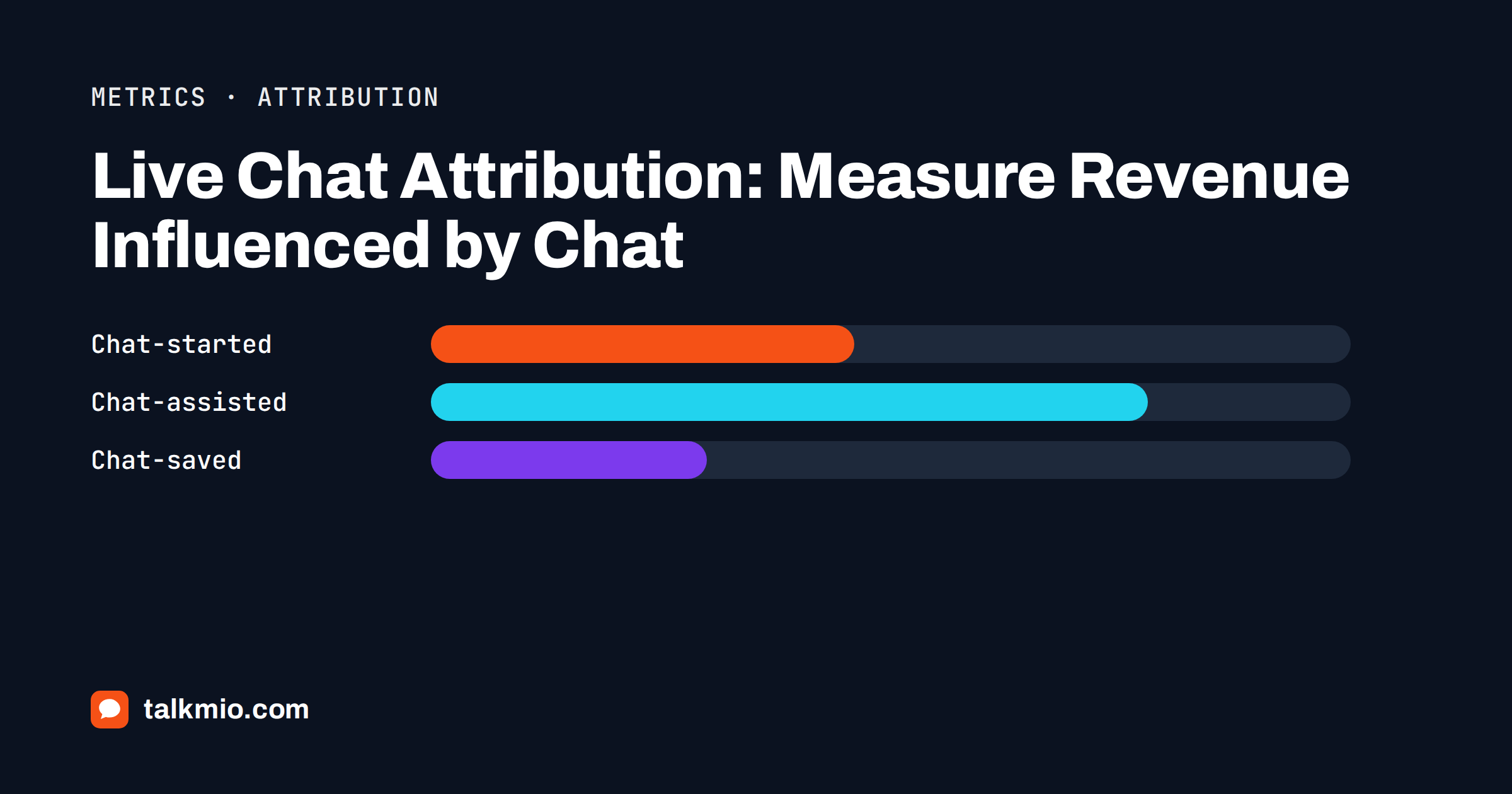
- Chat-started. The visitor began as a stranger, opened the chat and became a lead or customer in the same conversation or soon afterwards.
- Chat-assisted. The visitor was already in your funnel, used chat to resolve a doubt and then bought. Chat did not create the interest, but it removed a blocker.
- Chat-saved. The visitor was about to leave, a question was answered and the sale was kept. This one is the hardest to prove and the easiest to overclaim.
Most chat value lies in the second and third groups, which standard last-click reports tend to miss. That is why a sensible chat attribution plan uses more than one lens, and why you should be modest about the numbers.
Why Your Analytics Probably Undercounts Chat
Web analytics tools credit conversions to a source such as organic search, paid search or e-mail. A chat is not a source. It happens in the middle of a visit that already has a source, so the sale is credited to that source and chat gets nothing.
There are other gaps. Chats often happen on one device, while the purchase happens later on another. The visitor may ask a question in chat and then phone, or answer through e-mail after an offline message. Google explains how its own models spread credit in its guide to attribution in Analytics, and the key point is that every model works only with the events it can see.
The conclusion is not that chat attribution is impossible. It is that you must create the link yourself, by capturing an identifier in the chat that you can later match to an order or a lead.
Four Methods That Work With Any Live Chat Tool
| Method | What it tells you | Effort | Main pitfall |
|---|---|---|---|
| E-mail matching | Which customers and revenue involved a chat, one by one | Medium | Visitors who never give an e-mail are missed |
| Chat-versus-no-chat cohorts | Whether chatting visitors convert at a different rate | Low | Selection bias: motivated buyers chat more |
| Page or time holdout | The causal effect of showing chat at all | High | Needs enough traffic and a clean split |
| Agent tagging | Which chats led to a sale, in the team’s own words | Low | Depends on agents remembering to record it |
Method 1: e-mail matching
This is the most reliable method. Make the chat collect an e-mail address, then match that address to orders in your shop, billing system or CRM. In Talkmio, the pre-chat form can be none, optional or required, and Contacts keeps everyone who ever wrote with their conversation history. When the team is offline, visitors are asked for an e-mail before the first message anyway.
The routine is a monthly export of chat contacts and a lookup against your orders. Add up the revenue from matched customers whose first order came after the chat, and keep a second figure for existing customers who ordered again. The first is closer to chat-started revenue and the second to chat-assisted revenue. Our guide to live chat contact history shows how to use the records.
Method 2: chat-versus-no-chat cohorts
Compare the conversion rate of visitors who chatted with those who did not. It is quick, and it usually shows chat visitors converting much better. Do not read that as proof of impact. People who open a chat are often already motivated. The comparison is useful as a health indicator, not as a claim that chat caused the difference.
Method 3: a holdout test
The cleanest proof is to show the chat to some visitors and hide it from others, then compare. If your traffic allows it, split by page group or by time period, and keep everything else equal. Run the test long enough to cover full weeks. A holdout needs volume: with only a few hundred visits a week, noise will swamp the effect. For smaller sites, fall back on e-mail matching.
Method 4: agent tagging
Ask agents to record the outcome in an internal note at the end of a chat: sale, lead, order number, no outcome. Talkmio’s reply box has an Internal note that only your team sees, and a priority and status on each conversation. A simple convention, such as starting a note with the word outcome followed by the result, makes the notes easy to search by name, e-mail or text in the Inbox. This method takes seconds per chat and gives you stories as well as numbers.
Live Chat Attribution Step by Step
Here is a plan that a small team can run in a month.
- Decide the outcomes. Choose one or two: order placed, quote requested, demo booked or account created. Write the definition down.
- Capture an identifier. Ask for an e-mail address in the pre-chat form or early in the conversation. Optional works well for most sites, because a required field can reduce the number of chats.
- Record the source. Use the live visitor data, which shows country, page, device and source, and note the landing page in the first message when it matters.
- Tag outcomes. Agents write an internal note with the result. Mio’s handoffs show up as needs-human chats, which makes them easy to review.
- Match monthly. Export contacts, match them against orders or leads, and compute chat-started and chat-assisted revenue separately.
- Report with ranges. Present a conservative figure and a generous figure, and explain the gap.
Our article on live visitor monitoring describes what you can see about visitors in real time, and the live chat reports and analytics guide lists the numbers worth tracking next to revenue.
Use UTM Parameters to Keep the Source Clean
Chat attribution only works if the source of the visit is recorded properly. Tag your campaign links with UTM parameters so that analytics and your records agree. Google’s page on collecting campaign data with custom URLs describes the parameters, even though it covers an older version of Analytics, because the UTM idea is still the same.
Then add the campaign name to the chat record whenever a visitor mentions it, or copy the landing page address into an internal note for chats that lead to a sale. With a consistent naming scheme, you can later answer questions such as which campaign produced the visitors who chat most.
A Worked Example With Illustrative Numbers
The following numbers are invented to show the arithmetic, not to suggest a benchmark. Suppose a web shop has 100 chats in a month. Matching e-mail addresses to orders shows that 12 chatters placed an order after the chat, with an average order value of 80. That is 960 in chat-started or chat-assisted revenue, depending on whether they were new or returning.
Now compare costs. If the plan, plus a share of agent time, costs a known amount for the month, divide it by the number of chats to get the cost per conversation. Our guides on live chat ROI and cost per conversation show the formulas.
Finally, apply caution. Suppose half of those twelve would have ordered anyway. The conservative figure is then 480. Reporting both numbers, 960 as the upper bound and 480 as the cautious estimate, is more credible than a single large number. A decision maker who sees a range trusts it more than one who sees a perfect result.
Which Method Should You Start With?
Pick by traffic and effort. A site with a few hundred chats a month should start with e-mail matching and agent tagging, because both work at small volumes and give you named examples to learn from. A site with thousands of daily visits can add a holdout test once the basics are in place. The cohort comparison is free, so run it alongside the others, but label it as an indicator.
Whatever you choose, keep the method the same for several months. A trend measured the same way every time is worth more than a perfect number measured once. When the plan changes, for example you add a second website or a new channel, note the date in your report so a jump or a dip can be explained later.
Common Mistakes in Live Chat Attribution
- Counting every chatter as a win. Many chats are support questions from existing customers. Separate them from sales conversations.
- Ignoring the delay. People often buy days after a chat. Look at a window of at least two weeks.
- Double counting with other channels. A customer who chatted and clicked an advertisement is in both reports. State that overlap openly.
- Forgetting offline chats. Messages left when the team was away and answered by e-mail still count. Keep them in the matching.
- Measuring chat only by revenue. Chat also reduces effort, answers pre-sale doubts and improves reviews. Pair revenue with measures such as chat-to-lead conversion rate.
- Assuming a chat tool sends events to analytics. Check your tool’s documentation. Talkmio’s documentation describes reports, contacts and an API on Ultimate and above, but does not describe analytics event output, so plan on e-mail matching.
Privacy When You Match Chats to Customers
Linking chats to orders means combining personal data. Tell visitors in your privacy notice that you may connect conversations with purchases, collect only what you need and keep the matched file in a controlled place. Data in Talkmio is stored on servers in the EU, in Germany, and you can export or delete it at any time. Delete your working export when the analysis is done. For the wider rules, see the GDPR and live chat guides on this blog.
Frequently Asked Questions
What is live chat attribution?
It is the practice of working out how much revenue or how many leads a live chat helped to win. Because analytics tools credit the visit’s source and not the chat, you usually have to link chats to orders yourself, for example by matching the e-mail address collected in the conversation.
How do I track sales that come from live chat?
Collect an e-mail address in the chat, export your chat contacts monthly and match them against orders or CRM leads. Add agent notes with the outcome for chats that end in a sale. Report chat-started and chat-assisted revenue separately and show a conservative and an upper estimate.
Can Google Analytics show revenue from live chat?
Only if chat sends events that you configure, and even then it credits the source of the visit. Check your chat tool’s documentation for any analytics events. When none are described, rely on e-mail matching, agent notes and a comparison of visitors who chatted with those who did not.
Do visitors who chat really convert better?
Usually they do, but the difference is not proof that chat caused it, because motivated visitors are more likely to open a chat. Use the comparison as an indicator, and use a holdout test or e-mail matching when you need to estimate the real contribution of chat.
How long after a chat should I count a sale?
Use a window that fits your sales cycle. For a web shop, two weeks is a reasonable start, because many people ask a question and buy later. For B2B services, a window of one or two months may suit better. Keep the same window for every report.
Is it worth setting up attribution for a small site?
A light version is. Make the e-mail field optional in the pre-chat form, write outcome notes after sales chats and match your contacts to orders once a month. It takes an hour and gives you evidence for whether chat deserves a paid plan or more staff time.
The Bottom Line
Live chat attribution works when you create the link yourself: capture an e-mail address, record outcomes and match chats to orders on a regular schedule. Report a range, separate chat-started from chat-assisted revenue and treat cohort comparisons as indicators, not proof. Start with a free Talkmio account, set the pre-chat form to optional and run your first monthly match.