
 Lietuviškai
 Deutsch
 Français
 Русский
 Español
 Polski
 Italiano
 Українська
 Čeština
 Português
 日本語
 Latviešu valoda
 Eesti
 Magyar
 Bahasa Indonesia
 Türkçe
 हिन्दी
 Ελληνικά
 العربية
 ไทย
 Tiếng Việt
 Română
 Bahasa Melayu
 বাংলা
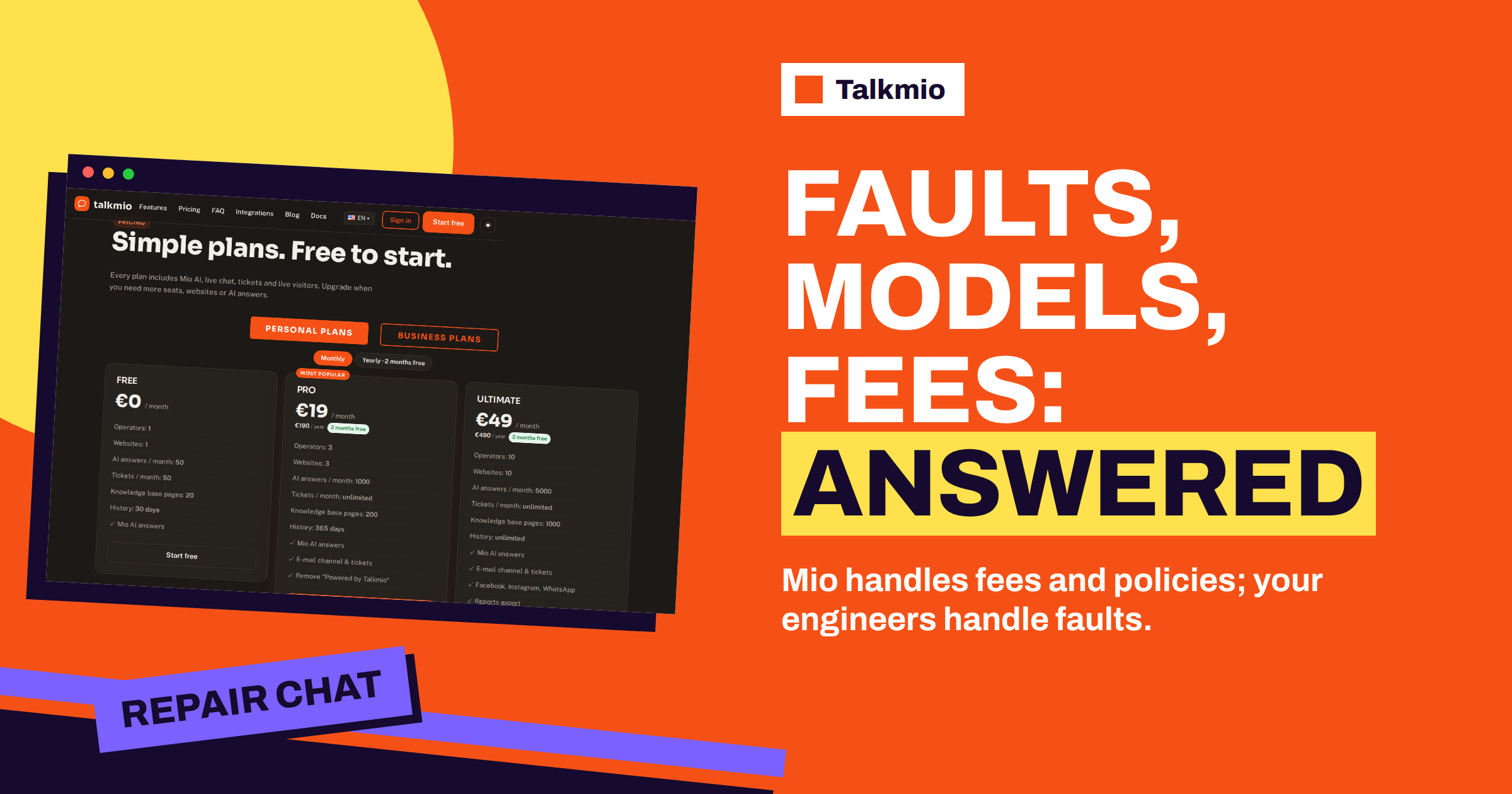
Appliance repair chat starts with a broken machine and an impatient owner. The washer will not drain, the oven has stopped heating, the fridge is warm, and the person writing wants to know three things at once: can you fix it, how much will it cost and how soon can someone come. This guide shows how to use Talkmio so that Mio, the AI assistant, answers the repeated questions about fees, brands and policies from your own pages at any hour, while faults, model numbers and visit slots go to a person who can judge them. The result is a chat that saves your dispatcher’s phone and still sends the real problems to the right people.
Product facts come from the Talkmio documentation and the pricing page. The repair examples are general patterns, and your own prices, areas and rules always come first. Mio does not diagnose faults, and this guide shows how to make sure it does not try.
What Customers Ask an Appliance Repair Business
The questions repeat in a predictable order. The table sorts them by who should answer.
| Question group | Examples | Who should answer |
|---|---|---|
| Brands and appliance types | Do you repair this brand? Do you fix ovens, dishwashers, dryers? | Mio, from your services page |
| Fees | Call-out fee, hourly rate, whether the fee is deducted from the repair | Mio, from your price page |
| Service area | Do you come to my town? Which days? | Mio, from your area page |
| Warranty | Is the repair guaranteed? How long? | Mio, from your warranty terms |
| The fault | The machine makes a noise, shows an error code, leaks | A person; Mio never diagnoses |
| Model and parts | Is a part available? Is it worth repairing this old model? | A person, with the model number |
| Visit slots and changes | Can someone come today? Can we move the visit? | A person, from your schedule |
| Safety | Gas smell, sparks, water near sockets | A person at once, with a clear safety line |
The documentation says that Mio answers only from your content and never invents prices or policies. It lists the situations in which Mio hands the chat to a person: when it cannot answer from your content, when the visitor asks for a person, when the visitor complains or when the visitor asks about a specific order. In an appliance repair chat, a specific job already booked counts as an order question and goes to your team.
Teach Mio Your Services, Areas and Fees
Sign in, open Mio AI and then the Knowledge base. Add your website, and Mio reads every public page on the same domain while respecting robots.txt. Then check that the pages say what customers want to know, in plain words: which appliance types and brands you repair, which towns you cover, the call-out fee and what it includes, how the hourly rate works and what the guarantee covers. If your fees depend on the appliance or distance, put them in a table. A price list can also be uploaded as a PDF, DOCX or CSV file, up to 15 MB. Our guide to an AI chatbot with a CSV price list shows how to lay it out.
The documentation lists Q&A pairs and free text as sources, and the plan limits how many pages Mio keeps. Use question and answer pairs for the facts that live nowhere else: “Do you repair appliances out of warranty? Yes, and the call-out fee is the same.” Short, dense sources are better than long, repetitive ones.
Write the Rules: No Diagnosis, No Promised Slots
The business instructions tell Mio what you sell, which tone to use and what it must never promise. For an appliance repair chat, a few rules keep the chat useful and safe:
- Never diagnose a fault or say what is wrong with a machine.
- Never say a repair will be possible, cheap or quick before an engineer has seen the model.
- Never promise a visit time; point to the booking page or hand the chat to a person.
- If a visitor mentions a gas smell, smoke, sparks or water near electrics, tell them to switch off and disconnect only if it is safe, to contact the emergency service for gas, and hand the chat to the team at once.
- Ask for the brand, the model number and the error code, and hand the chat to a person with those details.
Test the rules of your appliance repair chat in Try Mio, which shows the answer, which knowledge pieces were used and how long it took. Ask the awkward questions: “My washing machine is making a grinding noise, what is broken?” and “Can you come in an hour?” The right behaviour is a polite statement that an engineer needs to look, a request for the model details and a hand-off. Our guide to writing AI chatbot instructions explains how to phrase rules that hold.
Model Numbers and Error Codes: The Details That Save a Visit
The most valuable thing an appliance repair chat can collect is the model number, because it turns a vague complaint into a job your engineer can prepare for. Most appliances carry a rating plate with the model and serial number, and customers who know where to look can send them in a message. Add a short note to your content explaining where to find the plate on common appliances and why you ask. The overview of home appliances shows how varied the range is, which is exactly why a model number matters.
The pre-chat form, set in the widget settings as none, optional or required, can ask for a name or an e-mail before the first message. Use it with care: a required form adds friction for a customer whose washing machine is flooding the kitchen. An optional form, together with Mio’s request for the model in the conversation, is usually enough. Mio cannot look up parts or compatibility, and the documentation does not describe such a function, so those questions are handed to a person.
Fees Without Surprises
The cheapest way to lose a customer is a fee that surprises them. State the call-out fee clearly, say whether it is deducted from the repair, say how the hourly rate works and describe what happens if the appliance cannot be repaired. Mio repeats exactly what the page says, so the clarity of the chat depends on the clarity of the page. If the cost of a repair depends on the part, say so, and explain that a fixed quote comes after the engineer has seen the machine. Never let the chat estimate. A rule such as “never quote the price of a repair, only the call-out fee and the hourly rate” removes the risk of a promise you cannot keep.
Repair or Replace?
Many customers ask whether an old appliance is worth repairing. The honest answer depends on the model, the fault and the age, and it is a judgement for an engineer. Publish general guidance if you have it, for instance a short page on when repair usually makes sense, and let Mio repeat that page. Individual cases go to a person, who can look at the model number the customer sent.
A Sample Day
It is eight in the evening. A customer writes that her dishwasher stopped mid-cycle and asks whether you repair that brand and what a visit costs. Mio answers from your pages: yes, the brand is on your list, the call-out fee is the stated amount and the visit area includes her town. She asks whether someone can come tomorrow, and Mio explains how booking works and offers to pass the chat to the team. A second customer writes in broken English about an oven. Mio replies in the language he writes in, and the chat window is translated too, as the documentation says. A third mentions a burning smell from a socket; the rule applies, and the chat reaches your Inbox with a “needs human” badge. Nobody is online, so an e-mail and a push notification on the mobile app go to the team, and the visitor is asked for an e-mail before the first message. In the morning the dispatcher sees three conversations with context, instead of three missed calls.
Warranty, Complaints and Repeat Visits
Warranty questions come in two kinds: general ones, such as how long your repair is guaranteed, and specific ones, such as whether this fault is covered. Mio can answer the first from your terms. The second belongs to a person who can see the earlier job. A customer who writes that the fault is back after a repair is complaining, and the documentation says Mio hands over complaints. Write the same rule in the instructions so that the chat is calm and quick: acknowledge, ask for the job details and pass it on. Convert the chat to a numbered ticket if the follow-up will take time, set a priority and add an internal note for the engineer. Our guide to converting a chat into a ticket shows when to do it.
Plan, Test and Launch Your Appliance Repair Chat
Write twenty questions as customers would type them: brands, appliance types, fees, areas, warranty, a noise, an error code, a leak, a gas smell, a rush request and a complaint. Run them in Try Mio and fix the gaps in your pages. Then test the hand-off in a private window with a request for a person. A one-person repair business can start on the Free plan, with one operator, one website, 50 AI answers a month and 20 knowledge base pages. A company with several dispatchers and engineers who share the Inbox will look at Pro, with three operators, 1000 AI answers a month, 200 pages and the e-mail channel, which turns forwarded mail into tickets. Check the pricing page for current plans. Our guide to live chat for home service businesses covers the neighbouring trades.
Run the Inbox Like a Dispatch Desk
Once your appliance repair chat is live, the Inbox becomes a small dispatch desk, and a few habits keep it orderly. Start the morning with the Unanswered filter, which shows what needs a person, and clear it before anything else. Use the assigned team member field so that each job has one owner, and set the priority from Low to Urgent: a leaking machine is Urgent, a question about a guarantee is Low. Typing a slash in the reply box inserts a quick reply, so keep a few ready for the usual hand-offs, such as the request for brand, model and error code. The Suggest button drafts a reply from your knowledge base, which helps a dispatcher who is on the phone at the same time.
Look at the Mio replied filter once a week and read a handful of conversations. Check that fees are current, that no diagnosis slipped in and that the tone is calm. A repair business changes prices, areas and hours several times a year, and each change should be followed by an update of the page and a click on Re-read, because sources are re-read on demand. The conditions of a guarantee are a particular risk: if your terms change, an old PDF or page may still say the old thing. The general idea of a warranty is simple, but the details are yours, so keep one current page and remove the others.
Frequently Asked Questions
Can Mio diagnose what is wrong with an appliance?
No, and it should not try. Write a rule that Mio never diagnoses and never promises a repair, then ask it to collect the brand, model number and error code and hand the chat to a person. An engineer judges the fault, the part and the cost.
Can Mio quote the price of a repair?
Only what your pages state, such as the call-out fee and the hourly rate. Mio answers from your content and never invents prices. Write a rule that repair prices are quoted only by a person after the model is known, and the chat will respect it.
What should happen if a customer mentions a gas smell or sparks?
Write a clear safety rule in the business instructions: advise contacting the emergency service where relevant, and hand the chat to your team at once. The chat arrives in the Inbox with a “needs human” badge, a browser notification and, if nobody is online, an e-mail and a mobile push notification.
Can the chat book a visit for me?
Mio answers from your content, and the documentation does not describe a booking integration. It explains how booking works and links your booking page, while a person confirms visit slots from the Inbox. Never let the chat promise a time you have not confirmed.
How do I get the model number from the customer?
Explain on your pages where to find the rating plate, and write a rule that Mio asks for brand, model and error code. The pre-chat form can ask for a name or e-mail, but keep it optional so a customer with a flooding kitchen is not slowed down.
Which Talkmio plan fits a small repair company?
Start on Free: one operator, one website, 50 AI answers a month and 20 knowledge base pages. When several dispatchers share the Inbox or you want forwarded e-mail turned into tickets, look at Pro with three operators, 1000 answers a month and the e-mail channel.
The Bottom Line
An appliance repair chat does its best work on the boring questions: fees, brands, areas and policies. Let Mio answer those from your pages, keep faults, parts and slots with your engineers, and write a safety rule you trust. Test twenty customer questions before launch. Start free with Talkmio and give every customer an answer, even when the phone is busy.