
 Lietuviškai
 Deutsch
 Français
 Русский
 Español
 Polski
 Italiano
 Українська
 Čeština
 Português
 日本語
 Latviešu valoda
 Eesti
 Magyar
 Bahasa Indonesia
 Türkçe
 हिन्दी
 Ελληνικά
 العربية
 ไทย
 Tiếng Việt
 Română
 Bahasa Melayu
 বাংলা
Dry cleaning chat is full of small, urgent questions. A customer has a wedding on Saturday and a stain on a jacket. Another wants to know whether you collect from the office. A third has a duvet that will not fit in the machine at home. Most of these questions have answers that are written on your price list and service page, yet they arrive by phone, one by one, during the hours when your team is busy at the counter or the presses. This guide shows how to use Talkmio so that Mio, the AI assistant, answers the repeated questions about prices, turnaround, pickup and care from your own pages at any hour, while stains, damage and the status of a specific order go to a person who can look at the garment. The result is a chat that reduces calls and keeps customers sure of what to expect.
Product facts come from the Talkmio documentation and the pricing page. The laundry examples are general patterns, and your own prices, turnaround times and policies always come first. Mio does not see your orders or garments, and this guide shows how to make that clear.
What Customers Ask a Laundry or Dry Cleaner
The questions repeat in a few families. The table sorts them by who should answer.
| Question group | Examples | Who should answer |
|---|---|---|
| Prices | Price of a shirt, a coat, a duvet, a wedding dress | Mio, from your price list |
| Turnaround | Standard time, express service, same-day cut-off | Mio, from your service page |
| Pickup and delivery | Areas, days, time windows, minimum order | Mio for the policy; a person for a specific slot |
| Items you accept | Leather, suede, curtains, rugs, trainers | Mio, from your list of services |
| Stains and care | Can you remove this stain? Is my coat dry-clean only? | A person, after seeing the item; Mio explains general policy only |
| Order status | Is my order ready? Can I collect today? | A person, from your system |
| Damage and lost items | A button missing, a garment not returned | A person |
| Business customers | Hotels, restaurants, uniforms, regular contracts | Mio for the offer; a person for quotes |
The documentation says that Mio answers only from your content and never invents prices or policies. It lists the situations in which Mio hands the chat to a person: when it cannot answer from your content, when the visitor asks for a person, when the visitor complains or when the visitor asks about a specific order. In a dry cleaning chat, “is my order ready?” is the textbook order question and always goes to your team.
Teach Mio Your Services, Prices and Turnaround
Sign in, open Mio AI and then the Knowledge base. Add your website, and Mio reads every public page on the same domain while respecting robots.txt. Then check that the pages answer the questions in plain words. A price list should list the common items with their prices, the express surcharge and the minimum order for delivery. A service page should state the turnaround for each service, the cut-off for same-day, the pickup areas and days and the items you do not accept. Prices by item fit well in a table or a file. The documentation lists PDF, DOCX, TXT, MD, CSV and HTML files up to 15 MB, so a price list exported from your system works. Our guide to an AI chatbot with a CSV price list shows how to structure one.
Add question and answer pairs for facts that fit on no page: “Do you clean wedding dresses? Yes, see the special services page for timing and price.” The documentation lists Q&A pairs and free text as knowledge sources, and the plan limits how many pages Mio keeps, so choose short, dense sources.
Stains and Garment Care: General Policy, Never a Promise
“Can you get this out?” is the question every cleaner hears, and the honest answer is “we have to see it”. Stain removal depends on the fabric, the substance, the age of the stain and what has already been tried at home. A chat that promises a result will produce disappointed customers and disputes. Write a clear policy on your pages, such as “We assess each garment on receipt and tell you before we start if a stain may not come out”, and let Mio repeat it. Write a rule that Mio never promises that a stain will be removed or that a garment will not shrink, fade or be damaged, and that it explains that the team assesses each item.
Care labels also raise questions. A customer who asks whether an item can be washed at home is asking for advice that depends on the label and the fabric. You may publish general guidance about symbols, and the overview of dry cleaning explains the process in general terms. For a specific item, Mio hands over to a person, who can ask for a photo of the label. Our guide to writing AI chatbot instructions shows how to word rules like these so that they hold.
Turnaround, Express and Cut-Off Times
Turnaround is where chat can save the most calls, since customers always ask “when can I have it back?”. State the standard time for each service, the express option and its surcharge and the daily cut-off, and Mio repeats them. Do not let the chat estimate a particular order’s readiness. A rule such as “never promise a ready date for a specific order; give the standard turnaround and offer to pass the chat to the team” avoids false promises. For busy periods, such as before a holiday, add a short note to the knowledge base, for example “Express slots are limited in the week before the holiday”, if it is true, use Re-read and remove it afterwards. Our guide to keeping prices and deadlines correct explains how to avoid wrong figures.
A Sample Day
It is seven in the morning, and the shop opens at nine. A customer on her way to work asks whether you collect from offices and what the minimum order is. Mio answers from the pickup page. At noon, another asks what you charge for a duvet and how long it takes. Mio gives the price and the standard turnaround. In the evening, a third writes that he has a stain on a suit for a wedding on Saturday and asks whether you can remove it by Friday. The rules apply: Mio explains that the team assesses each garment and offers to pass the chat on, and the conversation reaches the Inbox with a “needs human” badge. Because nobody is online, the visitor is asked for an e-mail before the first message, and your reply in the morning goes out as an e-mail. Three conversations, one human reply, and the one that mattered got it first thing.
Pickup and Delivery: Slots Are for a Person
If you offer collection and delivery, customers ask about areas, days and time windows. The policy is a fact, so write it plainly: which areas you serve, which days, the time windows and the minimum order or fee. A specific slot, such as “tomorrow morning at my address”, needs a person who sees the driver’s schedule, since Mio does not see it and the documentation describes no scheduling integration. Ask in the rules that Mio collects the address, the day and the contact before the hand-off, so that your reply can confirm a slot in one message.
The same applies to regular customers who want a standing pickup, such as a weekly collection. Publish the offer, and let Mio hand the request to your team with the details. Our guide to live chat for cleaning services covers a neighbouring trade with similar questions.
Order Status, Damage and Lost Items
Orders, damage and lost items are the conversations where tone matters most. Customers are worried about a garment they care about, and a fast, calm reply makes the difference. Mio hands over every question about a specific order. For damage or a missing item, write a rule that Mio responds with concern, asks for the order number or name and the date, and passes the chat on without discussing fault or compensation. You then reply with the facts. Convert the conversation to a numbered ticket if the follow-up will take time, set a priority and add an internal note with what you found. Our guide to where-is-my-order chats shows how to handle the most common version of this question.
Plan, Test and Launch Your Dry Cleaning Chat
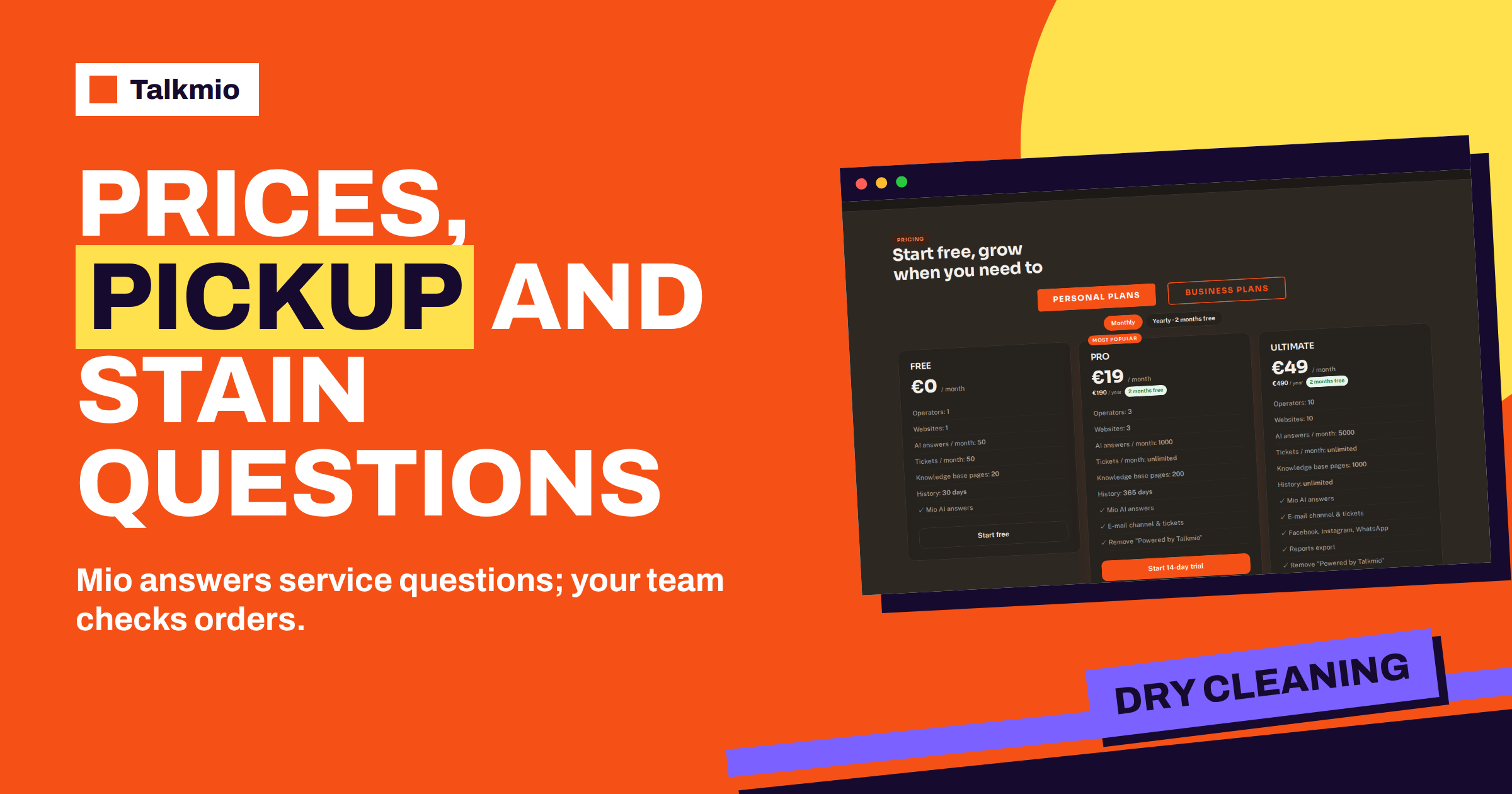
Write twenty questions as customers would type them: the price of a shirt, a coat and a duvet, express service, same-day, pickup, areas, a stain, leather, a wedding dress, a missing button, an order status and a complaint. Run them in Try Mio, which shows the answer, which knowledge pieces were used and how long it took, and fix the gaps. Then test the hand-off in a private window with a request for a person. A small shop can start on the Free plan, with one operator, one website, 50 AI answers a month and 20 knowledge base pages. A larger business with several branches or counter staff sharing the Inbox will look at Pro, with three operators, three websites, 1000 AI answers a month, 200 pages and the e-mail channel. Check the pricing page for current plans.
Keep a routine once the chat is live. Open the Mio replied filter once a week and read five answers, to check that prices and turnaround are current. Update the pages when the price list changes and use Re-read, since sources are re-read on demand. In Reports, the share answered by Mio alone and the hand-offs show how much the dry cleaning chat takes off your counter and where a page is missing.
Business Customers and Regular Contracts
Hotels, restaurants, salons and clinics send laundry in volume, and their questions differ from those of a private customer: price per kilo or per item, collection schedule, invoicing, turnaround for uniforms and linen. These customers value a quick, precise reply, and they usually want a person for the contract itself. Publish a short page for business customers with the services, the typical turnaround and how to ask for a quote, and let Mio repeat it. Write a rule that quote requests from businesses go to the team with the company name, the type and volume of items and the contact details. Our guide to wholesale requests in live chat shows how to qualify trade customers quickly without wasting their time.
For the general idea of the service, see the overview of laundry. A business that serves both private and commercial customers should keep the two sets of pages separate, so that Mio does not quote a private price to a hotel or the reverse. Every quarter, check both sets, since a dry cleaning chat that quotes an old commercial rate creates a dispute that no friendly tone can fix.
Frequently Asked Questions
Can Mio say whether a stain will come out?
No, and it should not. Stain removal depends on the garment and the stain, so write a rule that Mio never promises a result, repeats your policy that each item is assessed and hands the chat to a person who can look at it or at a photo.
Can the chat tell a customer if an order is ready?
No. Mio answers from your content and does not see your orders, and the documentation describes no order lookup. Questions about a specific order are handed to your team, who check your system and reply from the Inbox.
Can Mio book a pickup slot?
It can explain your pickup areas, days and minimum order. A specific slot needs a person who sees the driver’s schedule. Write a rule that Mio collects the address, the day and the contact, then hands the chat to your team.
How should the chat handle a damaged or missing item?
As a complaint, which the documentation says Mio hands to a person. Write a rule that it responds with concern, asks for the order number and date, and passes the chat on without discussing fault or compensation. You then reply from the Inbox, and a numbered ticket with an internal note keeps the follow-up organised.
What happens when the shop is closed?
Mio answers from your content. Questions that need a person arrive in the Inbox with a “needs human” badge, and you get an e-mail and a mobile push notification. Visitors are asked for an e-mail before the first message, and your reply goes out by e-mail.
Which Talkmio plan fits a small dry cleaner?
Start on Free: one operator, one website, 50 AI answers a month and 20 knowledge base pages. When several people share the Inbox, or you run more than one site, look at Pro with three operators, three websites, 1000 answers a month and the e-mail channel.
The Bottom Line
A dry cleaning chat works when it answers prices, turnaround, pickup and policies from your pages, and sends stains, damage and order status to people who can look at the garment. Write the rules, publish your standard times and test twenty customer questions before launch. Start free with Talkmio and let customers get an answer before the counter opens.