
 Lietuviškai
 Deutsch
 Français
 Русский
 Español
 Polski
 Italiano
 Українська
 Čeština
 Português
 日本語
 Latviešu valoda
 Eesti
 Magyar
 Bahasa Indonesia
 Türkçe
 हिन्दी
 Ελληνικά
 العربية
 ไทย
 Tiếng Việt
 Română
 Bahasa Melayu
 বাংলা
Diving school chat is full of first-timers. A person who has never dived wants to know whether they are allowed, which course to start with, what it costs, what they need to bring and whether it is safe. They ask late in the evening, often several schools at once, and the first school to answer clearly tends to win the booking. This guide shows how to use Talkmio so that Mio, the AI assistant, answers those repeated questions from your own pages at any hour, while medical, conditions and booking questions go to an instructor or the office, who can judge them. The result is a chat that welcomes beginners without ever pretending to be the person responsible for their safety.
Product facts come from the Talkmio documentation and the pricing page. The diving examples are general patterns, and your own courses, prices, certification rules and safety procedures always come first. Mio is not a medical or safety authority, and this guide shows how to make sure it never acts like one.
What People Ask a Diving School
The questions follow the path from curiosity to booking. The table sorts them by who should answer.
| Question group | Examples | Who should answer |
|---|---|---|
| Courses and levels | Which course for a beginner? How many days? What do I get at the end? | Mio, from your course pages |
| Prices and what is included | Price, kit, certification fee, boat trips | Mio, from your price list |
| Requirements | Minimum age, swimming test, languages of instruction | Mio, from your requirements page |
| Medical and fitness | Asthma, ear problems, medication, pregnancy, “am I fit to dive?” | A person; Mio never judges fitness |
| Equipment | Do I need my own mask? Can I rent a wetsuit? Sizes? | Mio for the policy; a person for sizes in stock |
| Dates and groups | Next course start, group size, private lessons | A person, from your schedule |
| Conditions and weather | Visibility, water temperature, whether the trip goes ahead | A person on the day; Mio for the written policy |
| Travel | Where to stay, how to reach the dive centre, parking | Mio, from your location page |
The documentation says that Mio answers only from your content and never invents prices or policies. It lists the situations in which Mio hands the chat to a person: when it cannot answer from your content, when the visitor asks for a person, when the visitor complains or when the visitor asks about a specific order. In a diving school chat, a question about a person’s health is the clearest example of a question that Mio must not answer, and you reinforce that with a written rule.
Teach Mio Your Courses, Prices and Requirements
Sign in, open Mio AI and then the Knowledge base. Add your website, and Mio reads every public page on the same domain while respecting robots.txt. Then check that each page answers what a beginner would ask, in plain words. A course page should say who it is for, how many days it takes, how the days are split between theory, pool or shallow water and open water, what is included in the price and what is not, and what certificate the student receives from which agency. If your price list changes by season, put it in a table or an uploaded file; the documentation lists PDF, DOCX, TXT, MD, CSV and HTML up to 15 MB. Our guide to an AI chatbot with a CSV price list shows how to structure one.
Add question and answer pairs for details that fit nowhere on a page: “Do I need to know how to swim? The requirements page lists the swimming test.” The documentation lists Q&A pairs and free text as knowledge sources, and the plan limits how many pages Mio keeps, so choose short, dense sources.
Write the Rules: Health and Safety Go to a Person
The business instructions tell Mio what you sell, which tone to use and what it must never promise. For a diving school chat, the rules matter more than in most trades, because the activity carries real risk:
- Never say whether someone is fit or safe to dive; for any health question, say that an instructor or the school’s medical process will answer, and hand the chat to the team.
- Never give safety advice beyond what your pages state, and never contradict the school’s written procedures.
- Never promise that a trip or a course will go ahead on a given day; explain the written weather policy and hand over.
- Never promise a certification outcome or a time to qualify; repeat the course description only.
- Never confirm a place on a course; point to the booking page or hand over.
Test the rules in Try Mio, which shows the answer, which knowledge pieces were used and how long it took. Ask the hard ones: “I have asthma, can I do the discover scuba day?” and “Is it safe to dive tomorrow with this wind?” The right behaviour is a kind answer that an instructor will reply, and a hand-off. Our guide to writing AI chatbot instructions explains how to phrase rules that hold.
The Medical Questionnaire: Explain the Process, Not the Verdict
Most schools use a medical questionnaire or a physician’s form before a course. The chat can explain that the process exists, why it matters, where the form is and what happens if a student answers yes to a question on it. It must not predict the outcome. The sentence “a doctor must sign if you answer yes to any question” is a fact about your process if it is on your page; the sentence “asthma is fine for beginners” is a verdict, and it is not for Mio. Put the process in a short page, link the form and let Mio repeat the page. For individual cases, the hand-off goes to the instructor or the office, with the visitor’s question already in the conversation.
The same approach suits children and teenagers. State your minimum ages and the rules for parents or guardians on a page, and let Mio repeat them exactly. For the general picture of the sport and its training, the overview of scuba diving is a useful reference, and for the structure of courses, the overview of recreational diving.
A Sample Evening
It is nine in the evening in spring, and the dive centre is closed. A visitor asks which course suits a complete beginner and what is included in the price. Mio answers from the course and price pages. A second visitor asks whether he can bring his own mask, and Mio explains the equipment policy. A third writes that she has an ear problem and asks whether she can dive. The rule applies: Mio says warmly that an instructor will reply, and the chat goes to the Inbox with a “needs human” badge. Nobody is online, so the visitor is asked for an e-mail before the first message, an e-mail and a push notification reach the team, and the reply the next morning goes out as an e-mail. Three conversations, one human reply, and the one that involved health reached a person.
Equipment, Sizes and Rental
Equipment questions are numerous and mostly factual: what is included in the course price, what students must bring, which kit can be rented, whether your wetsuits cover all sizes and whether there is a deposit. State them on a page, and Mio repeats them. What Mio cannot do is check what is in stock today, and the documentation does not describe a stock lookup. So when a visitor asks whether you have a certain size on Saturday, the answer is a hand-off, and the instructions should say so. A short free-text note, such as “Rental wetsuits are limited in July, so ask early”, is useful if it is true; use Re-read after you add it and remove it after the season.
Conditions, Weather and Cancellations
Diving depends on the sea, the wind and visibility, and customers know it. They ask whether a trip will go ahead, what happens if it is cancelled and whether they get a refund or a new date. The policy is a fact, so write it down plainly and let Mio repeat it. The decision on a given morning is a judgement by your skipper or instructor, and it is not for the chat. For the day itself, put the message where customers will see it, such as your front page and your messaging, and tell your team to use quick replies for the standard notice. In the Inbox, typing a slash inserts a saved reply, and priority can be set from Low to Urgent so that tomorrow’s trip comes before next month’s.
Languages and Travelling Divers
Many diving customers are tourists, and many write in their own language. The documentation says that Mio replies in the language the visitor writes in and that the chat window itself is translated, so a visitor writing in German or Polish can get an answer from your English pages. Check the most important terms in Try Mio in the languages you expect, especially anything about safety and refunds. In the Inbox, the Translate button turns your draft into the visitor’s language, and Polish fixes grammar and tone, which helps an instructor who writes better underwater than on a keyboard.
Plan, Test and Launch Your Diving School Chat
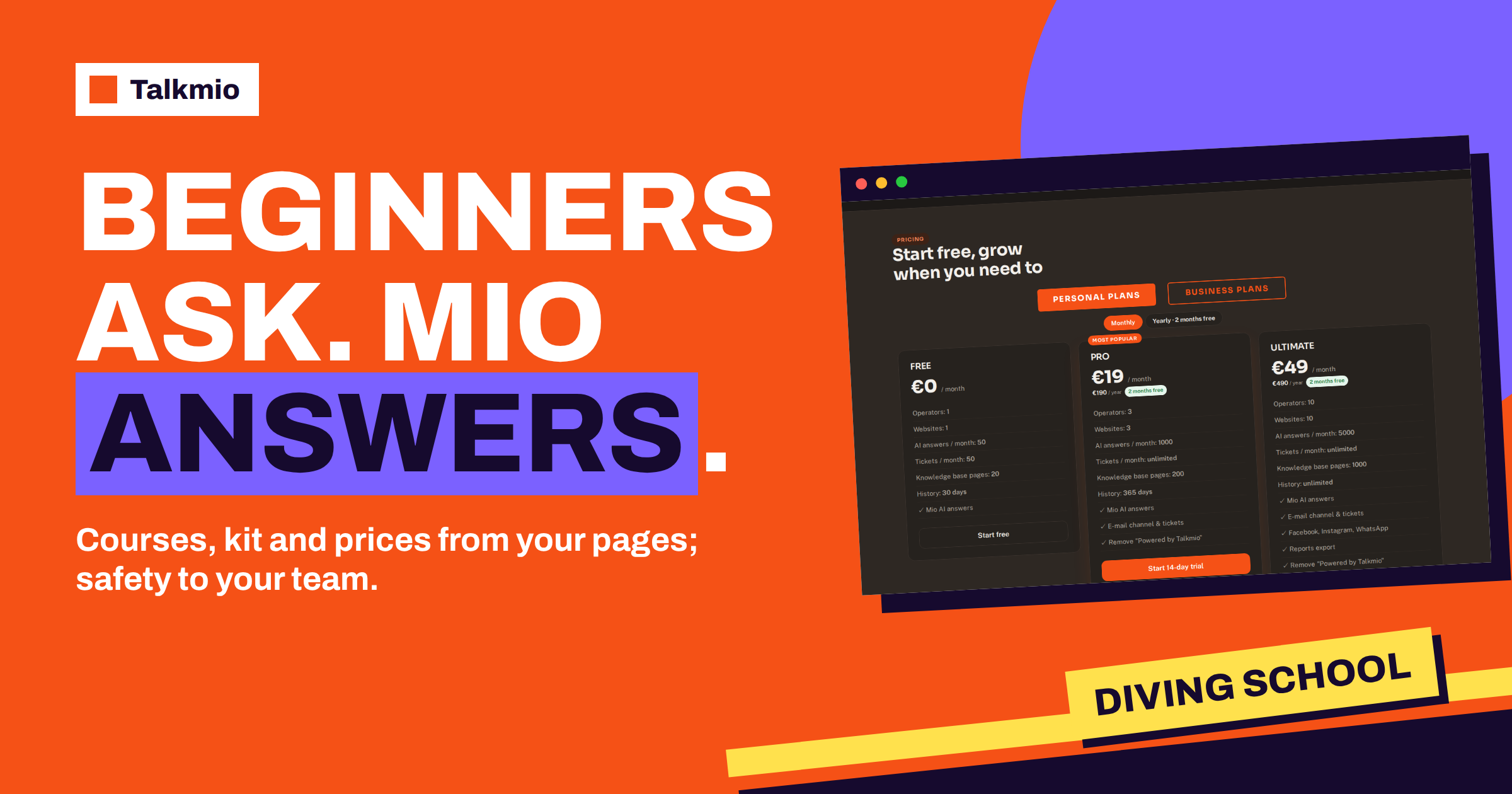
Write twenty questions as customers would type them: beginner course, price, what is included, age, swimming, asthma, ears, medication, mask, wetsuit, next date, weather, refund and a complaint. Run them in Try Mio and fix gaps in the pages. Then test the hand-off in a private window with a request for a person. A small school can start on the Free plan, with one operator, one website, 50 AI answers a month and 20 knowledge base pages. A centre with several instructors and a busy season will look at Pro, with three operators, 1000 AI answers a month, 200 pages and the e-mail channel. Check the pricing page for current plans.
Running the Inbox Through a Diving Season
A diving school chat follows the season, with a rush in spring as people plan holidays and again before the peak months. Prepare at the start: refresh the course dates and prices, use Re-read on the sources and run the twenty test questions again. During the busy weeks, keep the routine short. Open the Unanswered filter first, assign each conversation to an instructor or the office and set the priority from Low to Urgent, so that tomorrow’s dive comes before a question about next year. Use the Mio replied filter once a week to read a handful of answers the assistant gave, and check that prices are current and no health advice appeared.
Use internal notes, which only your team can see, to pass context between the office and the instructors: a note that a student has a form on file, or that a visitor asked about a private lesson, saves a second round of questions. If a conversation needs follow-up over days, convert it to a numbered ticket, give it a status of Open or Pending and let it live there instead of in someone’s memory. Our guide to support ticket statuses explains how to use the four states.
After the season, open Reports and look at conversations per day, the share answered by Mio alone, hand-offs, first-reply time and the busiest hours in your time zone. For a diving school chat, the hand-offs are the interesting figure: if most were medical and booking questions, the rules worked; if many were about prices or kit, a page needs work. According to the documentation, when a paid plan ends the account returns to Free and nothing is deleted, so a school that closes for the winter can decide whether to move down, provided its content fits the Free limits. Check those limits before you rely on this. Whatever you decide, keep the knowledge base current, because next spring’s first-timers will ask the questions of this spring’s.
Frequently Asked Questions
Can Mio say whether a person is medically fit to dive?
No, and it must not. Write a rule that Mio never judges fitness or safety, and that every health question goes to an instructor or your medical process. Mio can explain that the questionnaire exists and where the form is, then hand the chat to your team.
Can the chat promise that a trip will go ahead?
No. Weather and conditions are decided by your skipper or instructor on the day. Mio can repeat your written weather and cancellation policy. Write a rule that it never promises a trip, and hands those chats to a person.
Does Mio know which rental sizes are in stock?
No. Mio answers from your content and the documentation does not describe a stock lookup. It can explain the rental policy, and a person checks sizes and availability. Add a rule that stock questions go to the team.
How does Mio handle beginners who write in other languages?
Mio replies in the language the visitor writes in, and the chat window is translated too, according to the documentation. Questions in one language can find answers written in another. Test your important terms in Try Mio first, especially refunds and safety wording.
What happens when nobody is online?
Mio answers from your content. Questions that need a person arrive in the Inbox with a “needs human” badge, and you get an e-mail and a mobile push notification. Visitors are asked for an e-mail before the first message, and your reply goes out by e-mail.
Which Talkmio plan fits a small diving school?
Start on Free: one operator, one website, 50 AI answers a month and 20 knowledge base pages. When several instructors share the Inbox, or the season needs more answers, look at Pro with three operators, 1000 answers a month and the e-mail channel.
The Bottom Line
A diving school chat should welcome beginners with clear answers about courses, prices and kit, and it should send every health, conditions and booking question to a person. Write the safety rules first, prepare the pages and test twenty beginner questions. Start free with Talkmio and be the school that answers first, without ever answering what only an instructor should.