
 Lietuviškai
 Deutsch
 Français
 Русский
 Español
 Polski
 Italiano
 Українська
 Čeština
 Português
 日本語
 Latviešu valoda
 Eesti
 Magyar
 Bahasa Indonesia
 Türkçe
 हिन्दी
 Ελληνικά
 العربية
 ไทย
 Tiếng Việt
 Română
 Bahasa Melayu
 বাংলা
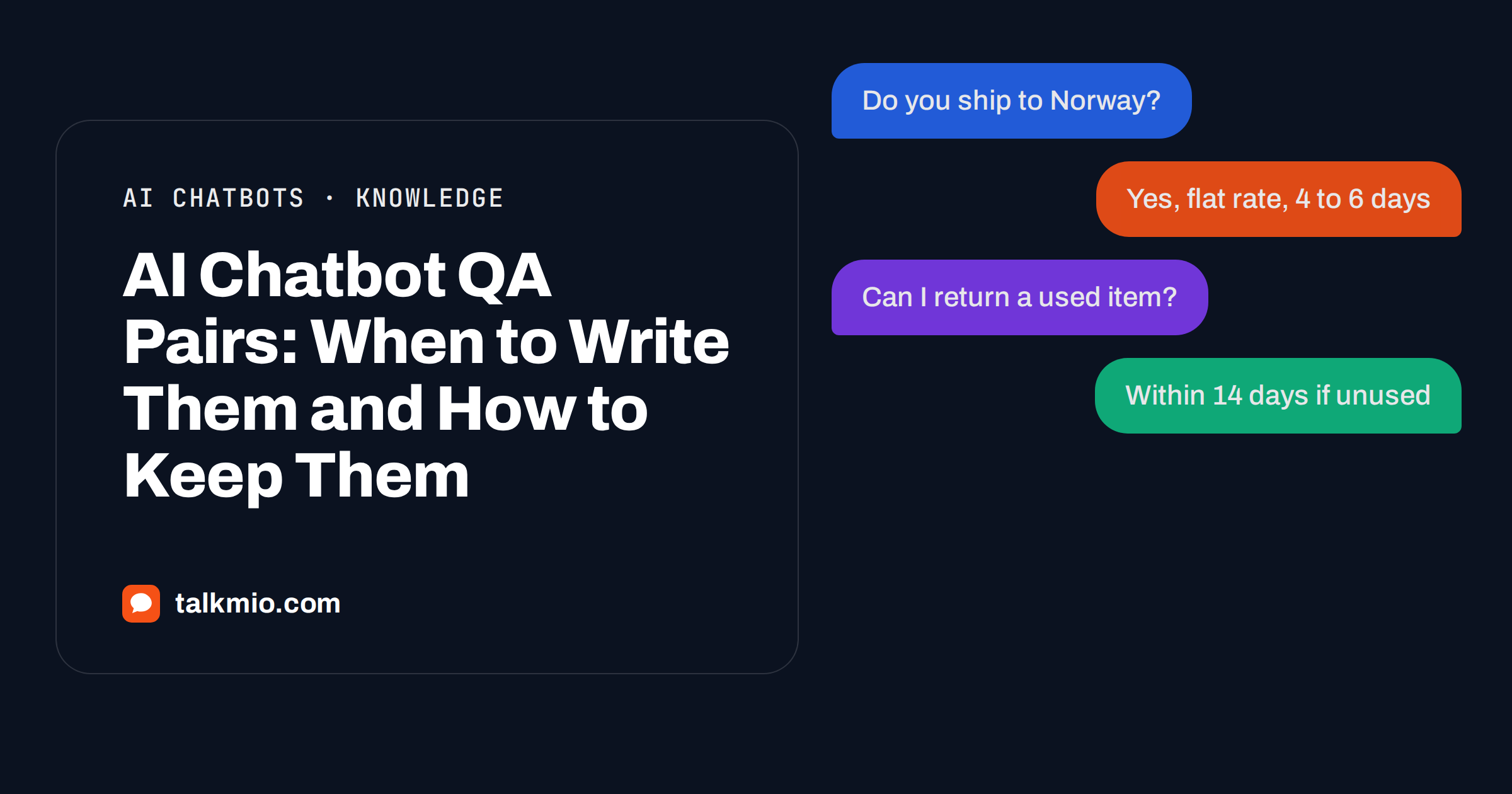
AI chatbot QA pairs are the simplest and most precise way to teach an assistant something your website does not say clearly. A pair is one question as a customer would ask it and one answer as you want it given. No crawling, no guesswork about which paragraph the assistant will pick. Used well, a handful of pairs repair wrong answers and fill gaps within minutes. Used badly, they become a second, conflicting copy of your website. This guide explains when to write them, how to phrase them and how to keep them accurate.
Talkmio is an AI live chat for websites. Its assistant, Mio, answers only from the content you give it. In the knowledge base you can add your website, single pages, question and answer pairs, free text or files such as PDF, DOCX, TXT, MD, CSV and HTML. Pairs are one of those sources, and they behave differently from the others, which is why they deserve their own rules.
The Five Ways to Teach Mio
| Source | Best for | Watch out for |
|---|---|---|
| Website crawl | Everything already published on your public pages | Outdated pages and vague wording are repeated as they are |
| Single pages | One important page that sits outside your main domain | Must be re-read when the page changes |
| Files | Price lists, manuals, policies and terms | Long documents bury the one fact you need |
| Free text | Background about the business, tone and context | Hard to review and easy to let drift |
| Question and answer pairs | Exact answers to specific questions | Duplicates that disagree with your pages |
Think of the sources as layers. The crawl and the files provide breadth, because they carry everything you have already written. Pairs provide precision, because you choose both the question and the answer. The article on knowledge bases for AI chatbots explains the layers in more depth.
When AI Chatbot QA Pairs Are the Right Tool
The website says nothing
Most sites have holes: a question customers ask daily that no page answers. It might be whether you deliver to a certain country, whether you accept a payment method or whether an item can be returned if opened. Write the answer as a pair, and then add it to the website later if it deserves a page. The pair gives you an answer today.
The website says it badly
A policy buried in a long paragraph is easy for people to miss and easy for an assistant to mangle. A pair can state the same policy in two clear sentences. Keep the pair consistent with the page, and when you rewrite the page, delete the pair.
Mio gave a wrong or weak answer
Run a question through Try Mio, which shows the answer, the knowledge pieces used and how long it took. If the answer was wrong because the source was unclear, a pair is the fastest fix. If the answer was wrong because two sources disagree, fix the sources instead, as our guide to conflicting sources explains, because a pair added on top of a conflict only adds a third voice.
Exact wording matters
Some answers must be given word for word: a refund policy, a safety statement, a statement about what you do not do. A pair makes the wording explicit and reviewable. Use business instructions for rules about behaviour, and pairs for facts.
Local vocabulary and slang
Customers may use a different word for a product than you do. A pair that asks the question in their words and answers it with yours connects the two. This is useful in multilingual setups too: a question in one language finds answers written in another, so you can write a pair once in your main language and let Mio serve visitors in theirs.
When to Skip Pairs
- The answer already sits clearly on a page. A pair that repeats it is a second place to update and will eventually disagree.
- The answer is long. A pair is for short, self-contained facts. Put longer explanations on a page or in a file.
- The answer changes often. Prices and stock should live in one source that you update, not in several copies.
- The question needs judgement. If the answer depends on the customer’s situation, hand it to a person instead.
How to Write a Good Pair
Write the question in the customer’s words
Use the phrase a customer would type, not the term in your internal documents. “Can I change my order after paying?” is better than “Order modification policy”. Mio understands paraphrases, so you do not need ten versions of the same question. One clear question per pair is enough, and a pair that covers two questions at once is hard to maintain.
Answer first, then the detail
Begin with the direct answer, then the condition. “Yes, within 14 days if the item is unused and in its original packaging” is better than a paragraph that arrives at the answer in the last line. Keep it under about eighty words, and avoid relative terms such as “soon” or “recently” that will become false.
Make the answer self-contained
The answer should make sense without the question next to it, since Mio may use it as part of a longer reply. Name the thing you are talking about instead of saying “it”. If the answer needs a page, include the page’s name or address so the visitor can read more.
Avoid promises you cannot keep
Answers should describe policy, not guarantee outcomes. “We usually reply within one working day” is honest. “We always reply immediately” is not. Pairs are also not a place to create new commitments that are not on your website or in your terms. If a pair says something that the rest of your site does not, fix the site first.
Examples: Weak and Strong Pairs
| Weak pair | Strong pair |
|---|---|
| Q: Shipping. A: We ship worldwide with various carriers depending on circumstances. | Q: Do you ship to Norway? A: Yes. Orders to Norway ship with a flat rate and usually arrive in four to six working days. See our shipping page for the current rate. |
| Q: Returns policy A: Please see our terms. | Q: Can I return something I have opened? A: Unused items in their original packaging can be returned within 14 days. Opened items are accepted only if faulty. Start a return from your order page. |
| Q: Are you open? A: Yes, we are open on most days. | Q: Are you open on public holidays? A: We are closed on public holidays. Our support team replies on the next working day. |
The weak pairs are vague, repeat a heading or point nowhere. The strong ones answer a question a real customer would ask and give enough detail to act on.
Find the Right Questions to Write
Do not invent pairs from your imagination. Take them from real conversations. In the Inbox, filter for conversations Mio could not answer, and sort the questions by how often they appear. Read the hand-offs too, because each one shows a place where content was missing. Reports show the share answered by Mio alone, which tells you whether the gap is large or small. The article on testing an AI chatbot before launch shows how to build a list of test questions from the start.
Work in small batches. Write five to ten pairs, test them in Try Mio with several phrasings, check which knowledge pieces were used and then go live. After a week, read the new conversations and repeat. A hundred untested pairs create more problems than ten tested ones. For the wider practice of keeping content current, see our guide to knowledge base updates.
A Worked Example: One Week of Pairs
Imagine a small online shop. On Monday the owner opens the Inbox, filters for conversations that Mio handed over and finds six repeated questions: delivery to a neighbouring country, a payment method, returns of opened items, gift wrapping, opening hours on holidays and whether prices include tax. Three of the six are answered on the website but buried; three are not answered at all.
On Tuesday the owner writes six pairs, each with a direct answer and a link to the relevant page, and tests every one in Try Mio with two phrasings. Two answers need a second sentence about conditions. On Wednesday the pairs go live. By the following Monday the owner reads the new conversations: five of the six topics are now answered by Mio, and one question about gift wrapping reveals a missing option that is added to the website. The pair for gift wrapping is then deleted in favour of a proper page. That small cycle, repeated weekly, is how a knowledge base improves without a big project.
Keep Pairs Under Control
Pairs are the part of the knowledge base that people forget. A website is visible, so someone notices when a page is wrong. A pair sits inside the account, so it can stay wrong for months. Put three habits in place.
- Give each pair an owner. The person who owns delivery owns the delivery pairs. When policy changes, that person changes them.
- Review on a calendar. Once a quarter, read every pair against the current website and delete the ones that duplicate pages or no longer apply.
- Change the source first. When something changes, update the website or the file, then the pair. Never let the pair become the only place the truth is written.
Also check how your plan counts knowledge items. The plan limits how many pages Mio can keep, and the numbers differ by plan: Free allows 20 knowledge base pages, Pro 200 and Ultimate 1000. Review the current figures on the pricing page before you plan hundreds of entries, and ask support at [email protected] if you are unsure how a source is counted.
Pairs, Instructions and Handoff Together
Pairs answer facts. Business instructions shape behaviour: the tone, what you sell and what Mio must never promise. Handoff covers the cases where no content should answer, such as a complaint or a question about a specific order. Use each for what it does best. A rule like “never quote delivery dates” belongs in the instructions, while “How long does delivery to Norway take?” belongs in a pair. Our guide to chatbot instructions shows the split in more detail. For the wider idea of an FAQ as a customer-facing resource, the overview of FAQs is a handy reference, and the page on question answering explains the research field behind these systems.
Frequently Asked Questions
How many AI chatbot QA pairs do I need?
Fewer than you think. Start with the five to ten questions that customers ask most often and that your website does not answer clearly, test them, then add more from real unanswered conversations. A small, accurate set beats a large set nobody maintains.
Should I write several versions of the same question?
Usually not. Mio understands paraphrases, so one clear question in the customer’s words is enough. Several versions multiply the maintenance work and raise the chance that one copy is changed and another is forgotten. Add a second phrasing only when a customer uses a very different word that Mio misses in testing.
What happens if a pair disagrees with my website?
The assistant has two sources that say different things, and the answer may vary. Fix the cause: update the page or the pair so they agree, and prefer to keep one source of truth. Use Try Mio to see which knowledge pieces were used.
Can I write pairs in one language for all visitors?
Yes. Mio answers in the visitor’s language, and a question in one language can find an answer written in another. Write pairs in your main language, test a few questions in other languages, and add a pair in a specific language where wording must be exact.
Are pairs better than uploading a FAQ file?
They serve different jobs. A file is good for many answers in one document, while pairs are good for individual facts you want to review and change one by one. Many teams use both, with the website as the base and pairs as corrections.
How do I know a pair works?
Test it in Try Mio, which shows the answer, the knowledge pieces used and the time taken. Ask the question in two or three phrasings, then read real conversations after launch to confirm that customers get the answer you intended.
The Bottom Line
AI chatbot QA pairs are a scalpel, not a hammer. Use them for exact answers where your website is silent or unclear, write them in customers’ words, keep them short and give each one an owner and a review date. Let the website and files carry the breadth and let pairs carry the precision. Start free with Talkmio, add your first ten pairs from real questions and watch how many conversations Mio can now finish by itself.