
 Lietuviškai
 Deutsch
 Français
 Русский
 Español
 Polski
 Italiano
 Українська
 Čeština
 Português
 日本語
 Latviešu valoda
 Eesti
 Magyar
 Bahasa Indonesia
 Türkçe
 हिन्दी
 Ελληνικά
 العربية
 ไทย
 Tiếng Việt
 Română
 Bahasa Melayu
 বাংলা
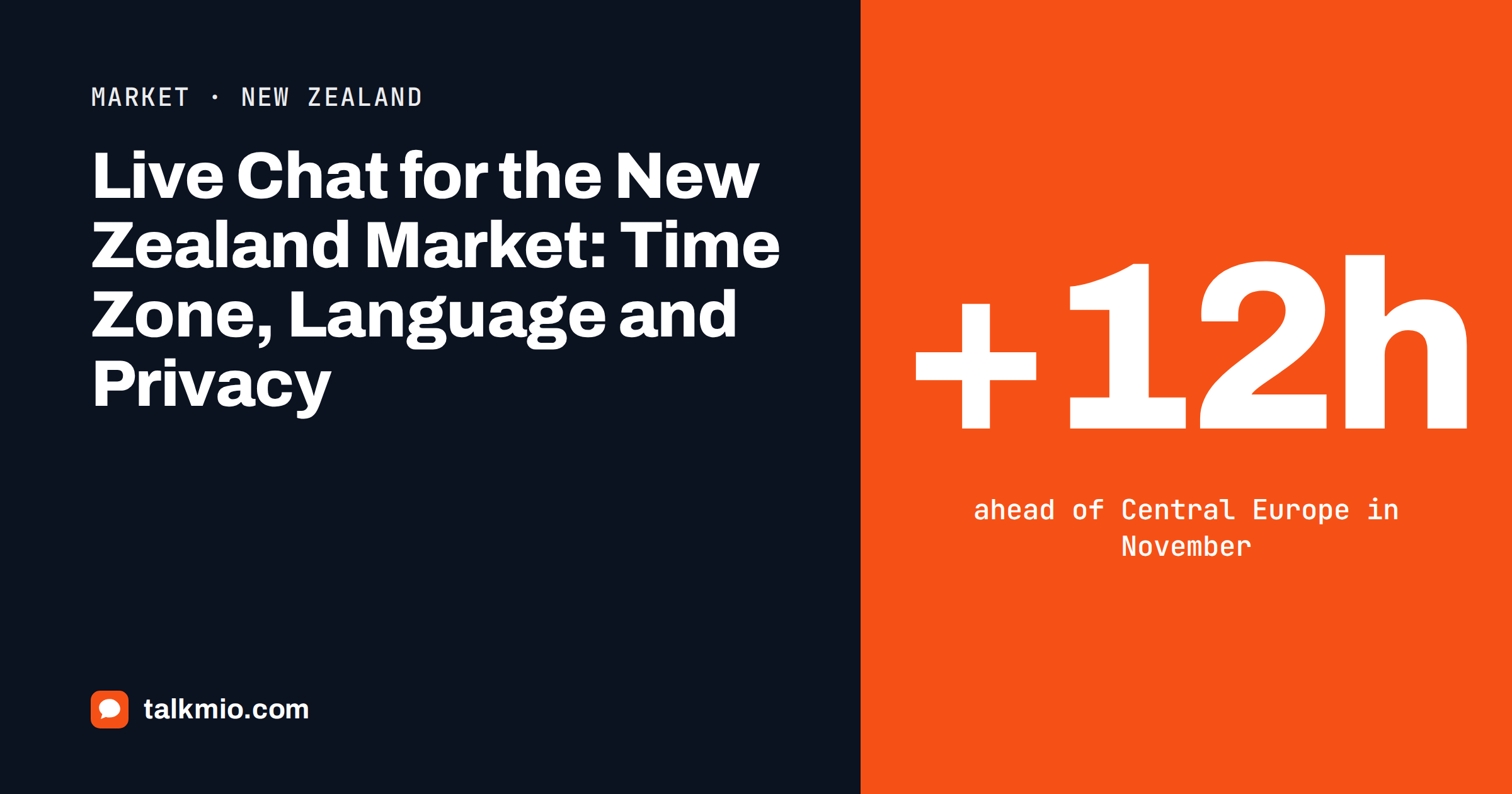
Live chat for the New Zealand market has to solve a problem that most other markets do not: the customer is asleep when your team in Europe or North America is working. New Zealand sits near the far edge of the time zone map, its customers are friendly, direct and quick to leave a shop that does not answer, and its consumer and privacy laws are clear about what you may promise and what you may do with data. A chat that answers instantly from your own content, knows the local words and hands over properly when the team wakes up will feel local even if your office is on the other side of the planet. This guide covers language, tone, the time difference, delivery questions, consumer law and privacy for businesses selling to New Zealanders.
Talkmio is an AI live chat for websites. Its assistant, Mio, reads your website, FAQ and uploaded documents, answers only from that content in the visitor’s language and hands the conversation to your team when it cannot answer, when the visitor asks for a person or complains. For a market twelve hours away, that first answer outside office hours is the main benefit.
Live Chat New Zealand Market: The Time Difference Comes First
New Zealand uses New Zealand Standard Time, UTC+12, and moves to daylight time, UTC+13, from late September to early April. In early November it is already on UTC+13. For a team in Central Europe, that means that a lunchtime visitor in Auckland writes when it is the middle of the night in Berlin, and the New Zealand business day ends before yours begins. Without a plan, every NZ visitor meets an empty chat for most of their day.
That makes the offline setup the most important setting you will touch. Set business hours in the widget so visitors see when a person answers. Write an offline text with a concrete reply window: “We reply within one working day, New Zealand time. For orders and deliveries, leave your e-mail and order number.” When the whole team is offline, Talkmio asks visitors for an e-mail before their first message and your later reply goes out as an e-mail, so nothing is lost. Reports show busiest hours in your time zone, which makes it easy to see which hours matter. For wider staffing ideas, read our guide to follow-the-sun live chat support and the one on offline hours and shift planning.
| Time in New Zealand (NZDT) | What your chat should do |
|---|---|
| Morning, 8 to 12 | Mio answers; hand-offs wait for your team, so promise a reply by e-mail |
| Afternoon, 12 to 17 | Same; this is when many shoppers ask about delivery and returns |
| Evening, 17 to 22 | The busiest hours for consumer shops; make sure the offline text is accurate |
| Overnight | Mio keeps answering; overnight hand-offs queue for the next shift |
Consider a small overlap shift. A person who starts early in Europe or works a few evening hours can clear the queue of hand-offs when New Zealand is at its busiest. Measure the benefit in Reports after a month before you commit.
Language and Tone in New Zealand
English is the main language of business, and Kiwi English has its own vocabulary and spellings, closer to British than American. Customers write “jandals”, “togs”, “chilly bin” and “dairy” for what others call sandals, swimwear, cool box and corner shop, and a visitor searching for “trainers” may type “sneakers”. Use local words in your content where they are natural, and test a few in Try Mio. The wider linguistic picture, including Māori and New Zealand Sign Language, is summarised in the overview of languages of New Zealand.
Te reo Māori is an official language, and greetings such as “Kia ora” are widely used in everyday business English. Using them is welcome when it is natural, and awkward when it is forced. Two practical points: write Māori words with macrons correctly, such as Māori and Aotearoa, and remember that visitors often type without them. Add both spellings to your content where it matters for search, so that a question about “Maori” finds the same page as one about “Māori”. Mio replies in the language the visitor writes in, so a message written fully in te reo may need a person; test it before you promise anything.
The tone is friendly, direct and low on hype. New Zealanders dislike pushy selling and exaggerated claims, so write short, honest answers with the next step clear. A casual, warm style works, but avoid imitating slang.
Delivery, Returns and Rural Areas
Delivery questions dominate many NZ chats. The country is long and thin, with two main islands, and a parcel to Auckland differs from one to a rural address in Southland or the Chatham Islands. Customers ask whether you ship within New Zealand, how long it takes, whether rural delivery costs extra and whether the courier needs a signature. If you ship from overseas, they ask about duty and GST at the border, and how long international transit takes.
Write a New Zealand page with delivery methods, times by region, fees, rural surcharges, return addresses and who pays for returns. Put it in the knowledge base so Mio can answer from it, and add a business instruction to never quote a delivery date for a particular order. For a specific parcel, Mio hands over to your team, which can check the tracking. The guide to live chat for seasonal businesses helps with peaks, and New Zealand has its own: the summer holidays in December and January, Boxing Day sales and the southern winter, which falls in the northern summer. Public holidays such as Waitangi Day and Matariki move delivery times, so keep a holiday note updated and tell Mio about it via the knowledge base. The article on AI chatbots and opening hours explains how to keep hours accurate.
Prices, GST and Payment Questions
Goods and Services Tax in New Zealand is 15 percent, and consumer prices are normally shown including GST. State clearly whether your prices include it, whether you invoice with a GST number and how overseas shipments are treated. Payment questions include whether you accept local bank cards, bank transfer, PayPal and buy-now-pay-later services. List exactly what you accept and let Mio answer from that list. If a payment fails, Mio should explain your policy and then pass the case to a person who can look it up, because Mio hands over when the visitor asks about a specific order.
Consumer Law and What Your Chat May Promise
New Zealand consumer law, including the Consumer Guarantees Act and the Fair Trading Act, sets rules about goods being of acceptable quality, matching their description and not misleading customers. The official Consumer Protection website explains the rights in plain language. For a chat, the practical lesson is simple: do not let the assistant promise something your pages do not, and do not let it deny a right the law gives. Mio answers only from your content and never invents prices or policies, so the way to stay safe is to make the content accurate.
Review your returns and warranty pages with a New Zealand adviser if you sell there, write them clearly and avoid blanket statements such as “no refunds under any circumstances”. Add a business instruction to hand over any complaint about faulty goods to a person, so that a decision is made by someone who knows your obligations. Mio hands over complaints automatically, and the conversation lands in the Inbox with the full history.
Privacy: The Privacy Act 2020
New Zealand’s Privacy Act 2020 sets information privacy principles for collecting, using, storing and disclosing personal information, and requires organisations to report serious privacy breaches. The Office of the Privacy Commissioner publishes guidance on its website. One principle deals with disclosing personal information outside New Zealand, which matters for a chat run from another country. In practice: tell visitors what you collect and why, collect only what the conversation needs, restrict who can read transcripts and be ready to give people access to their information and correct it.
Talkmio stores data on servers in the EU (Germany), only the conversation text and relevant knowledge base excerpts go to the AI model provider, and you can export or delete data at any time by writing to support. Describe that in your privacy notice, and confirm the legal details with an adviser. For a comparison with a neighbouring regime, read the Australian Privacy Act and live chat. Plans and limits are on the Talkmio pricing page.
Which Businesses Benefit Most
Overseas online shops that ship to New Zealand gain the most, because delivery, duty and return questions repeat every day and the answers live on a handful of pages. Software and service companies with New Zealand customers gain from answering how-to and billing questions overnight, and from a clear route to a person for anything account-specific. Tourism operators, accommodation and tour companies, whose customers plan months ahead from another time zone, can answer questions about seasons, inclusions and booking rules at any hour. Education providers recruiting students from New Zealand use the chat for fees, dates and entry requirements.
Whatever you sell, begin with the ten questions you answer most often by e-mail from New Zealand customers. If Mio answers eight of them correctly from your pages, you have a first release. If it does not, the gaps show exactly which pages to write. A live chat New Zealand market launch does not need to be perfect on day one; it needs honest hours, accurate content and a visible way to reach a person.
A Practical Setup for a Business Selling to New Zealand
- Publish a New Zealand page with delivery, GST, payment, returns and a holiday note.
- Add it and your policies to the Mio knowledge base, and test thirty questions with Kiwi words and macron variants.
- Write business instructions: friendly and direct, never quote delivery dates for orders, hand over complaints and faulty goods.
- Set business hours in New Zealand time and write an offline text with a clear reply window.
- Decide who clears hand-offs and when, and consider a short overlap shift.
- After a month, review Reports: busiest hours, hand-offs and the share answered by Mio alone, then adjust.
Frequently Asked Questions
What is the biggest challenge for live chat in New Zealand?
The time difference. New Zealand is twelve or thirteen hours ahead of Central Europe, so visitors write while your team sleeps. Let Mio answer from your content, set honest business hours and offline text, and plan a short overlap shift to clear hand-offs.
Which language should the chat use for New Zealand customers?
English, with local vocabulary where natural. Te reo Māori is an official language and greetings such as Kia ora are common, but most visitors write in English. Mio replies in the visitor’s language, so test any Māori messages before promising them.
Should I write Māori words with macrons?
Yes, write them correctly, for example Māori and Aotearoa. Many visitors type without macrons, so include both spellings in your content where search matters, so that a question about Maori finds the same answer as one about Māori, and test both in Try Mio.
Do prices need to include GST?
Consumer prices in New Zealand are normally shown including GST, which is 15 percent. State clearly whether your prices include it and how overseas shipments are handled, so Mio can answer from your content. Confirm the details for your business with an adviser.
Which privacy law applies to a chat for New Zealand visitors?
The Privacy Act 2020 sets rules on collecting, using and disclosing personal information, including disclosure outside the country. Tell visitors what you collect, limit access to transcripts and be ready to give access on request. Check the Privacy Commissioner’s guidance.
How can I try Talkmio for New Zealand without paying?
The Free plan needs no card and includes one operator, one website and 50 AI answers a month, enough to test real questions. Pro is 19 euro a month and Ultimate 49 euro a month, with a 14-day trial on paid plans and VAT added at checkout.
The Bottom Line
Live chat for the New Zealand market succeeds when it answers at once from accurate content, speaks plain friendly English with local words, deals honestly with the time difference and respects consumer and privacy law. Write one clear New Zealand page, set hours in local time and plan when hand-offs get cleared. Start free with Talkmio, test Kiwi questions in Try Mio and let your New Zealand customers get an answer while your team sleeps.