
 Lietuviškai
 Deutsch
 Français
 Русский
 Español
 Polski
 Italiano
 Українська
 Čeština
 Português
 日本語
 Latviešu valoda
 Eesti
 Magyar
 Bahasa Indonesia
 Türkçe
 हिन्दी
 Ελληνικά
 العربية
 ไทย
 Tiếng Việt
 Română
 Bahasa Melayu
 বাংলা
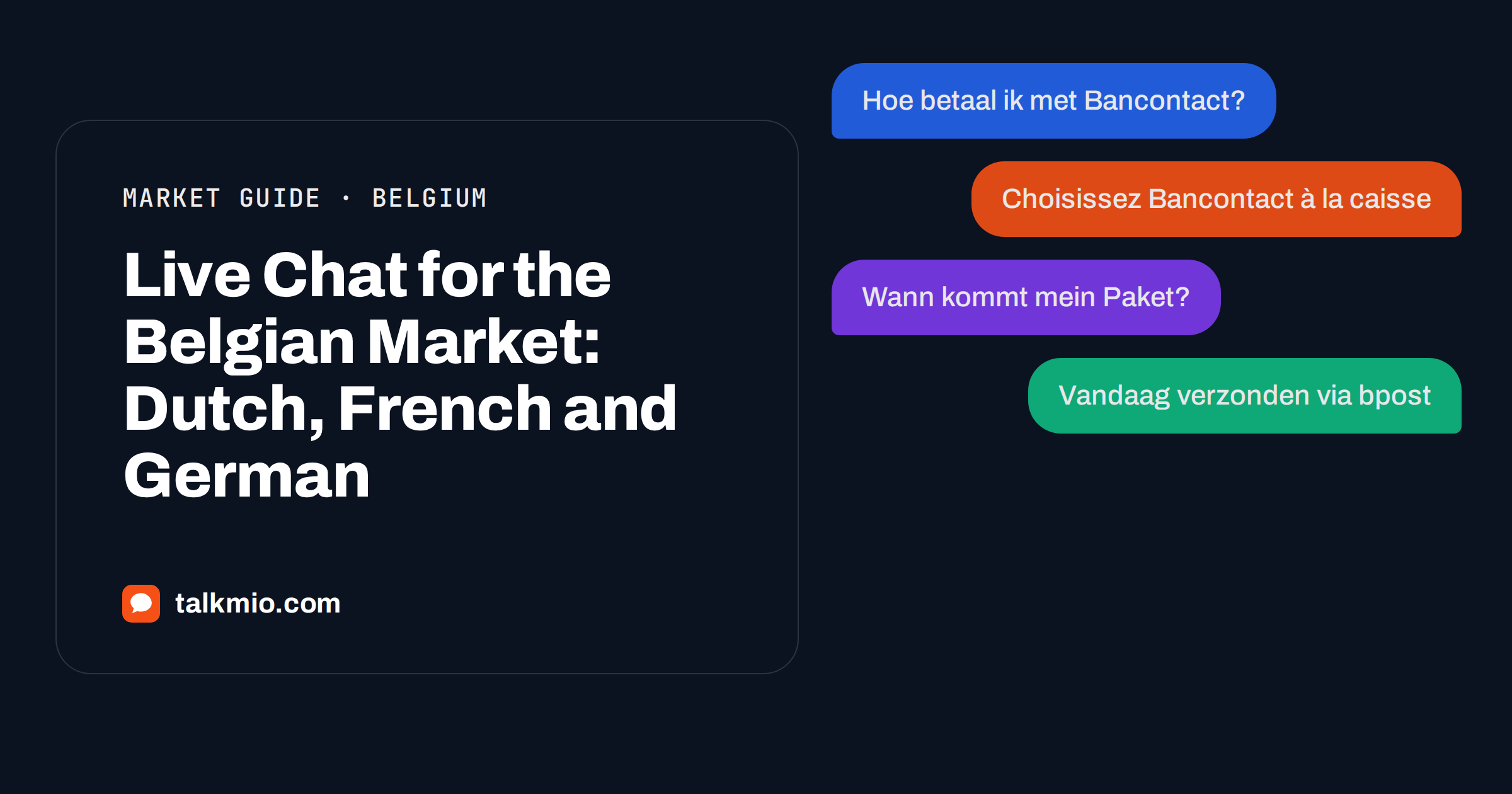
Live chat for the Belgian market starts with a fact that a single-language site cannot ignore: a Belgian visitor may write in Dutch, French or German, sometimes within the same week and the same shop. Flanders, Wallonia, Brussels and the German-speaking community each have their own habits, and a chat that answers only in English, or only in one national language, loses a large part of the audience. This guide covers how to set up a chat for Belgian visitors, what they ask about, and which local details your answers need to get right.
Talkmio fits this situation well because Mio replies in the language the visitor writes in, answering from your own content. You do not hire a native speaker for each language. You do, however, need content that is accurate about Belgian specifics, and that is what the rest of this article helps you prepare.
Why Live Chat for the Belgian Market Needs Three Languages
Belgium has three official languages, described in more detail in this overview of the languages of Belgium. Dutch is spoken in Flanders, French in Wallonia, and German in a small eastern region. Brussels is officially bilingual in Dutch and French, and in practice also full of English speakers. A Belgian shop therefore often serves several language groups from one domain, and visitors expect to be answered in the language they chose to write in.
Mio detects the language of each message and replies in it, and the widget text is translated too. Questions in one language find answers written in another, so a French question can be answered from a Dutch FAQ page. That helps a small team that writes its site once. For best results, though, give Mio core content in each language you actively sell in, because wording for delivery and returns matters. Our guides to the Dutch market, the French market and the German market go deeper on tone in each language.
Language Choice in the Widget
The widget language can follow the visitor automatically or be fixed in the Websites settings. For a Belgian site, auto-detect is usually the right choice, because the browser language of a Brussels visitor tells you little about the language they prefer to be served in. A visitor may use a French browser and write in Dutch to a Flemish shop, or the other way round. Let the message decide.
Use fixed language only when a site serves one language group by design, for example a regional shop for German-speaking Belgians. In that case set the welcome and offline texts in that language and write your business instructions in plain terms that Mio can follow. Remember that the instructions are where you say what you sell, the tone to use and what Mio must never promise.
What Belgian Visitors Ask About
The questions are familiar, but several have a Belgian form. The table below lists the most common themes and what the answer should contain.
| Topic | Typical question | What your content should state |
|---|---|---|
| Payment | Do you accept Bancontact? | Accepted methods, including Bancontact, cards and any mobile payment option you support |
| Delivery | Which carrier and how long? | Carrier names, cut-off times, delivery days, cost thresholds, collection points |
| Language | Can I get an invoice in French? | Which document languages you provide |
| VAT | Can I buy with a company VAT number? | How to enter the number, which rate applies, how invoices are issued |
| Returns | How do I send it back? | Return window, label process, who pays, refund timing |
| Cross-border | Do you ship to the Netherlands, France, Germany or Luxembourg? | Country list, costs and duties for neighbouring markets |
Each row is a page or a short FAQ entry that Mio can read. If the content is missing, Mio will hand the chat to your team rather than guess, which protects you but costs a conversation. The fix is almost always one more paragraph on your site.
Payments and Delivery Details
Belgian shoppers are used to Bancontact for debit payments, and a checkout without it raises questions in chat. If you accept it, say so on a payment page and name any other methods you support. If you do not, say that clearly too, so that Mio can give an honest answer and suggest the alternative you do offer. The same applies to mobile payment options that Belgian banks provide: state what your checkout actually supports and nothing more.
Delivery questions are just as concrete. Belgium is small and densely served, so shoppers expect quick delivery and ask about carriers, collection points and weekend options. Write down your carriers, cut-off times, delivery days and fees, and keep them in one place. If a customer asks where an order is, Mio hands the chat to your team because it cannot look at a specific order; make sure your team has tracking access. Write one delivery page that answers the routine questions before anyone needs to ask.
Tone and Forms of Address
Dutch-speaking Flemish customers move between the formal “u” and the informal “je”, and French-speaking customers expect “vous” in a first exchange. German-speaking customers usually expect “Sie”. Put your preferred register in the business instructions for each language, for example “address customers formally unless they use the informal form first”. A short line like this does more for perceived quality than any amount of fine-tuning elsewhere.
Avoid mixing standards. Belgian French and Belgian Dutch have their own vocabulary, but standard written forms are understood everywhere, and your site copy should be consistent. If your team replies in several languages, the Inbox can translate a draft into the visitor’s language and show visitor messages in yours, which helps a bilingual team cover a trilingual audience.
Staffing a Trilingual Chat Without Native Speakers
Few small teams in Belgium have a native speaker of every language at every hour. That is where the combination of Mio and the Inbox tools helps. Mio answers routine questions in the visitor’s language from your content, so most simple conversations never reach a person. When one does, the agent sees a “needs human” badge, the full history and a translation of the visitor’s messages, and can translate a draft reply back into the visitor’s language before sending.
Use that carefully. Machine translation is good for routine replies about delivery or opening hours, and weaker for complaints, legal wording or anything where tone carries weight. Decide in advance which topics a bilingual colleague reviews, and note this in your escalation policy. Agents should also tag conversations by language in their notes, so you can see after a month which language group asks the most questions and where your site content is thinnest.
Review the busiest hours in the Reports section as well. Flemish and Walloon visitors may peak at different times, and a clear picture of when each group writes lets you schedule the colleague who speaks that language, instead of covering every hour with every skill. Even a rough rota, with the French speaker in on Wednesday afternoons and the Dutch speaker in the mornings, beats an unstructured inbox.
Opening Hours, Holidays and Sales Periods
Belgian public holidays differ from neighbouring countries, and some, such as 21 July for the national day, matter to a shop’s delivery promises. Put holiday closures in your content and in your widget’s business hours. When the team is offline, visitors are asked for an e-mail before their first message and your later reply goes out by e-mail, so no one is left waiting without an explanation. Our guide to offline hours and shift planning explains how to set that up well.
Seasonal peaks are predictable too. Belgian retail has regulated sale periods in winter and summer, Sinterklaas and Saint-Nicolas bring early December orders, and Black Friday is now widely observed. Check the current rules before you publish dates, and add a short seasonal page that Mio can quote. Ahead of each peak, review the questions that came in last year and add the answers before the traffic arrives.
Privacy for Belgian Visitors
Belgium applies the GDPR, and its data protection authority publishes guidance in Dutch, French and German. For a chat widget the same basics apply as elsewhere in the EU: a privacy notice that mentions the chat, a clear retention period, access for those who need it and a route for requests. Talkmio stores data on servers in the EU (Germany) and lets you export or delete conversations at any time. Our GDPR and live chat guide contains the full checklist.
Because your visitors read in three languages, publish the privacy notice in each. A notice that exists only in English does not help a Walloon visitor who wants to understand what happens to the chat. The Belgian authority’s own site is a good place to confirm current expectations, and an attorney can confirm specifics for your business. See the Belgian Data Protection Authority for official guidance.
A Short Launch Checklist
- Publish delivery, payment, returns and VAT pages in every language you sell in.
- Set the widget language to auto-detect and test a message in each language.
- Write the preferred form of address for each language in the instructions.
- Add Belgian holidays to your content and business hours.
- Publish the privacy notice in each language and mention the chat.
- Check Mio’s answers with Try Mio before going live and fix any gaps on your site.
Setup is the usual one snippet before the closing body tag, or the WordPress plugin with a site key, and the documentation walks through both. Most of the work is content, not configuration.
Frequently Asked Questions
Does Mio answer in Dutch, French and German?
Mio replies in the language the visitor writes in, including German, French and Dutch among 30+ others, and the widget itself is translated. Answers come only from your content, so publish key pages in each language. Test a few real questions in every language with Try Mio before you go live.
Should I fix the widget language for a Belgian site?
Usually not. Visitors in Belgium switch between languages, and a browser setting rarely reflects the language they want to be served in. Auto-detect lets the visitor’s message decide. Fix the language only if your site serves one language group, such as a German-speaking regional business.
Can Mio tell a customer where their order is?
No. Mio hands the chat to your team when someone asks about a specific order, because it answers from your content and does not look up individual orders. Give your agents access to tracking, and publish a general delivery page so that routine questions are answered without a person.
Do I need separate content for each Belgian language?
You need accurate content in each language you actively sell in. Mio can answer a French question from a Dutch page, but wording about payment, delivery and returns is safest when it exists in the visitor’s language. Start with the pages that attract the most questions and add the rest over time.
Is chat data stored in the EU?
Yes. Talkmio stores data on servers in the EU (Germany). Only the conversation text and relevant knowledge base excerpts go to the AI model provider, and you can export or delete your data at any time. Mention the chat in a privacy notice written in the languages you serve.
What does Talkmio cost for a small Belgian shop?
There is a Free plan with one operator, one website and 50 AI answers a month, and no card is needed. Pro is €19 a month and adds three operators, 1000 AI answers and the e-mail channel. See the live pricing page for current details before you choose.
The Bottom Line
Live chat for the Belgian market works when it respects the country’s three languages, answers local payment, delivery and VAT questions with precise content, and handles privacy in the visitor’s language. Talkmio gives you the language handling and the hand-off to a person; you supply the Belgian details. Begin with auto-detect, a few strong pages and a test in each language. Create a free Talkmio account and try a Dutch, a French and a German question on your own site.