
 Lietuviškai
 Deutsch
 Français
 Русский
 Español
 Polski
 Italiano
 Українська
 Čeština
 Português
 日本語
日本語 Latviešu valoda
 Eesti
Eesti Magyar
 Bahasa Indonesia
 Türkçe
 हिन्दी
 Ελληνικά
 العربية
 ไทย
ไทย Tiếng Việt
 Română
 Bahasa Melayu
 বাংলা
বাংলা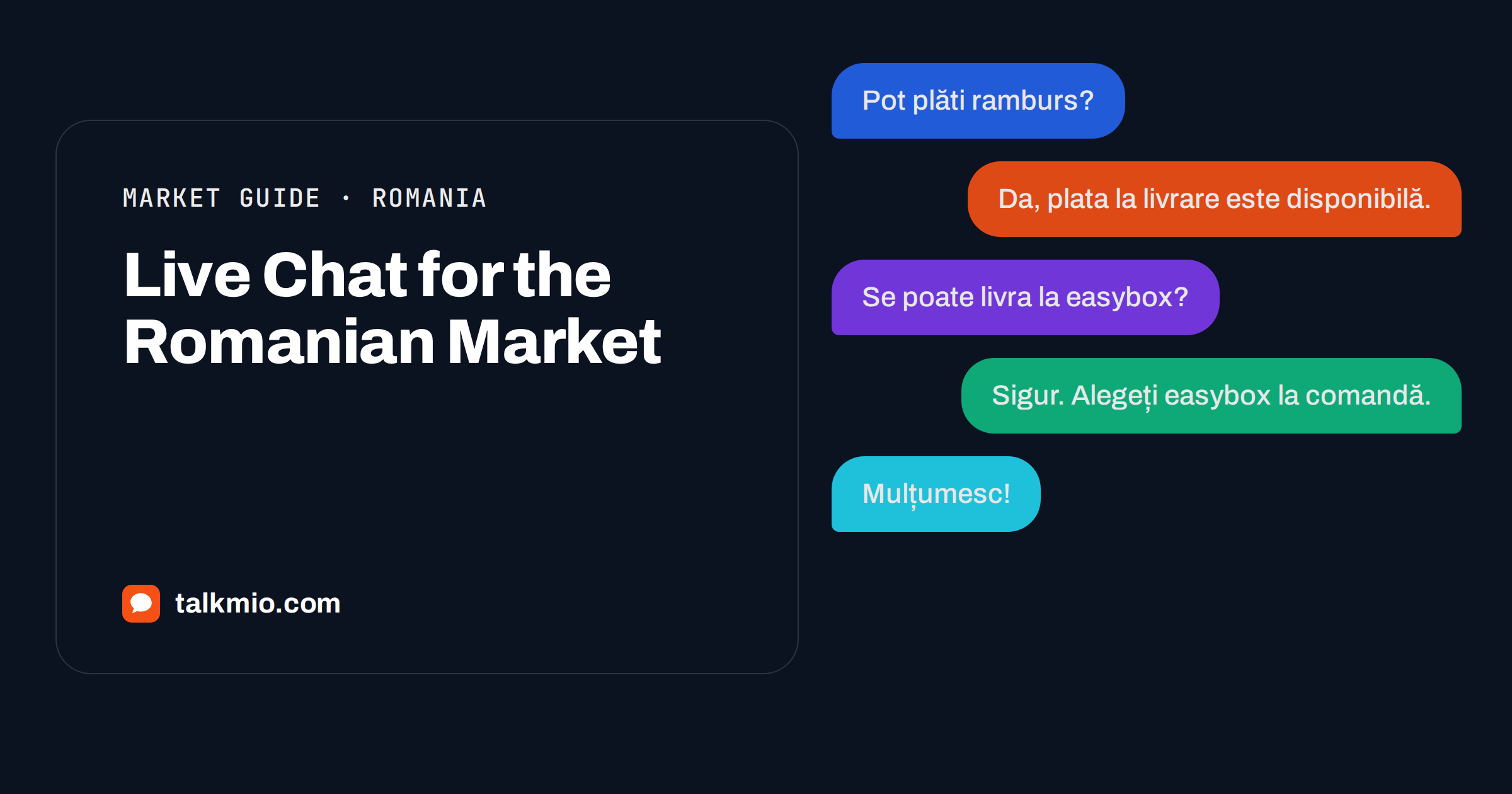
Running live chat for the Romanian market means answering a very particular set of questions: whether you accept cash on delivery, which courier brings the parcel, whether there is an easybox nearby, and how returns work. Get those right, in correct Romanian with the right level of formality, and chat becomes one of your best sales channels in Romania. Get them wrong and visitors simply go back to the marketplace they already trust.
This guide covers what is specific about Romanian shoppers and B2B buyers, how to set the tone, which questions to automate and which to leave to people, and how to configure an AI assistant such as Mio for Romanian visitors.
Why Live Chat for the Romanian Market Needs Its Own Setup
Romania is a large EU market of around 19 million people with fast-growing online shopping. Two things shape how people buy online there. First, a large marketplace, eMAG, set the standard for delivery speed, easy returns and constant availability. Your chat is compared with that experience whether you like it or not. Second, trust is still earned in small steps. Many shoppers want to confirm a detail with a person, or at least with something that answers like one, before paying.
That second point is why chat works well in Romania. A quick, specific answer about delivery cost or payment on delivery removes the last doubt. A generic “we will get back to you” often ends the visit.
There is also a wider audience than the country itself. Romanian is spoken in the Republic of Moldova, and a large Romanian diaspora lives in Italy, Spain, Germany and the United Kingdom. Visitors writing in Romanian may be ordering to an address abroad, so do not assume a Romanian postcode.
Language: Diacritics, Formality and Mixed Messages
Diacritics
Romanian uses five letters with diacritics: ă, â, î, ș and ț. Many people type without them on phones and keyboards, writing “multumesc” instead of “mulțumesc”. A good assistant must understand both forms and should always reply with correct diacritics, because a reply without them looks careless in formal contexts.
Watch for one technical trap. Older fonts and systems used cedilla forms (ş, ţ) instead of the correct comma-below forms (ș, ț). Make sure your canned replies, knowledge base and widget font use the comma-below letters, or some characters will render as boxes on certain devices.
Dumneavoastră or tu?
Romanian has a clear formal “you”, dumneavoastră (often shortened to “dvs.” in writing), and an informal tu. The safe default for most businesses is the formal form. Banks, clinics, insurers, law firms and B2B companies should stick to it. Fashion, gaming and lifestyle brands with younger audiences often use tu, and it can feel friendlier.
Whatever you choose, be consistent. Mixing forms inside one conversation, for example a formal greeting and informal replies, is noticed immediately. Put the choice in your assistant’s instructions and in your team’s canned responses.
Mixed-language messages
Romanian visitors often mix in English terms, especially for tech products: “voucher”, “tracking”, “refund”. Hungarian is also spoken by a significant minority in Transylvania, and some visitors may write in Hungarian. An assistant that replies in the visitor’s language handles this without separate teams. Talkmio’s Mio replies in the language the visitor writes in, and it can find the answer in a page written in another language, so a Romanian question can be answered from an English FAQ. Our guide to how AI chatbots handle multiple languages explains how that works.
Cash on Delivery and Payment Questions
Cash on delivery, known locally as ramburs or plata la livrare, has long been one of the most popular ways to pay for online orders in Romania. Card payments have grown quickly, but ramburs is still expected by many shoppers, especially outside the large cities and for first orders from an unknown shop.
This drives a predictable set of chat questions:
- “Pot plăti ramburs?” (Can I pay on delivery?)
- Is there an extra fee for cash on delivery?
- Can I pay by card to the courier?
- Can I open the parcel before I pay?
- Is there a limit on the order value for ramburs?
Every one of these should be answered on a clear page of your website, in Romanian, and then answered instantly in chat. An AI assistant can only give accurate answers if the facts exist in your content. If you do not state the cash-on-delivery fee anywhere, a well-built assistant will not invent it and will hand the question to your team instead.
Prices should be shown in lei (RON). Romania has not adopted the euro, and quoting euro prices to Romanian shoppers creates confusion about the final amount.
Couriers, Lockers and “Where Is My Parcel?”
Delivery questions are the single biggest category in Romanian e-commerce chat. Several courier companies are well known to shoppers, including Fan Courier, Sameday, Cargus, DPD and GLS. Parcel lockers have become very popular, especially Sameday’s easybox network, and many shoppers now expect locker delivery as an option.
Typical questions:
- Which courier do you use and how long does delivery take?
- Can I choose delivery to an easybox or another locker?
- How much is delivery, and is it free above a certain amount?
- Where is my order? (usually with an order number)
The first three are perfect for automation because they have the same answer for everyone. Put them on a delivery page and let the assistant answer from it. The fourth is different. Order status is personal, so it should go to a person or to your order system. Talkmio’s Mio hands over automatically when a visitor asks about a specific order, which is the right behaviour here.
Consumer Rights Questions Chat Will Get
Romanian consumers are protected by EU consumer law, enforced locally by the national consumer protection authority, ANPC. The most common chat questions are about the right to return goods bought online.
Under EU rules, shoppers generally have 14 days to withdraw from an online purchase without giving a reason, and a legal guarantee applies to faulty goods. The EU’s Your Europe guide to consumer contracts summarises the obligations for sellers.
In chat, do not improvise legal answers. Write a clear returns page in Romanian that covers:
- how many days the customer has to return an item;
- who pays for the return delivery;
- how and when the money is refunded, including for ramburs orders;
- how to start a return: form, e-mail or courier pickup;
- which products cannot be returned and why.
Then let the assistant quote that page and hand complaints to a person. A complaint handled calmly in chat rarely becomes a formal complaint to the authority.
Data Protection: GDPR and the Romanian Authority
Romania applies the GDPR like every EU country, and the national supervisory authority is ANSPDCP (dataprotection.ro). For live chat the practical questions are the same as elsewhere in the EU: what the widget stores, how long you keep conversations, where they are stored, and what your privacy notice says.
Some points worth handling from the start:
- Privacy notice in Romanian. Mention the chat, what data it collects and why.
- Data location. Many Romanian B2B buyers ask where data is stored. Talkmio stores data in the EU (Germany), and only the conversation text and relevant knowledge-base excerpts are sent to the AI model provider.
- Retention. Decide how long you keep chat logs and delete them on request.
- Payment data. Never ask for card numbers in chat.
Our article on GDPR and live chat covers what a widget may store in more detail.
Timing: Time Zone, Hours and Seasonal Peaks
Romania is on Eastern European Time (UTC+2, UTC+3 in summer), one hour ahead of most of Central Europe. If your team sits in Berlin or Warsaw, the Romanian morning starts before yours.
Chat volume follows the local calendar. Plan for these peaks:
- Black Friday, which is very large in Romania and usually happens in November, often earlier than the US date.
- Christmas and the days before the courier cut-off.
- 1 March (Mărțișor) and 8 March, when many people buy small gifts and flowers.
- Orthodox Easter, which often falls on a different date from Western Easter.
- Back to school in September.
Update your delivery and cut-off information before each peak. Outdated delivery promises in chat are one of the fastest ways to generate complaints.
What to Automate and What to Leave to People
The table below is a starting point for splitting Romanian chat traffic between an AI assistant and your team.
| Question type | Example in Romanian | Who should answer |
|---|---|---|
| Cash on delivery | Pot plăti ramburs? | AI, from your payment page |
| Delivery time and cost | În cât timp ajunge coletul? | AI, from your delivery page |
| Locker delivery | Se poate livra la easybox? | AI, if the option is on your site |
| Returns | Cum returnez un produs? | AI for the rules; a person for the case |
| Order status | Unde este comanda mea? | A person or your order system |
| Complaint | Am primit produsul deteriorat. | A person, always |
| Company invoice | Aveți factură pe firmă? | AI for the rule; a person for the details |
The last row matters for B2B sales. Romanian businesses often ask whether you can issue an invoice to a company (factură pe firmă), which requires the company’s tax code (CUI). Explain the process on your site so the assistant can answer, and let your team collect the details.
Setting Up Talkmio for Romanian Visitors
Talkmio needs no special configuration for Romanian, because Mio replies in the visitor’s language automatically. What makes the difference is your content and instructions.
- Publish the key pages in Romanian: delivery, payment (including ramburs), returns, warranty and contact. Mio reads your website and answers from it.
- Write business instructions that set the form of address, for example “Always use dumneavoastră. Never promise delivery dates; hand order questions to the team.”
- Test in Romanian with Try Mio: ask the ten questions above, with and without diacritics, and check which knowledge pieces each answer used.
- Set business hours in your local time. Outside them, visitors leave an e-mail and your reply goes out by e-mail.
- Connect WhatsApp and Facebook if your customers already message you there. Messaging apps are widely used in Romania, and on the higher Talkmio plans those messages arrive in the same Inbox.
If you sell in several countries, our guide to multilingual live chat without native speakers shows how to run all of them from one team.
Frequently Asked Questions
Should live chat for Romanian customers use dumneavoastră or tu?
For most businesses the formal dumneavoastră is the safer default, especially in finance, health, legal services and B2B. Brands with young audiences in fashion, gaming or entertainment often use tu successfully. The key is consistency: choose one form, write it into your assistant’s instructions and canned replies, and never mix the two in one conversation.
Do Romanian shoppers still use cash on delivery?
Yes. Cash on delivery, called ramburs, remains a common way to pay for online orders in Romania, even though card payments keep growing. Many shoppers use it for first orders from a shop they do not know yet. State clearly on your site whether you offer it, what it costs and whether the courier accepts cards.
Can an AI chatbot answer in Romanian with correct diacritics?
A good multilingual assistant understands Romanian written with or without diacritics and replies with correct ones. Test this before going live: ask several questions without diacritics and check the replies. Also make sure your own texts use the comma-below letters ș and ț, not the older cedilla forms.
What are the most common live chat questions in Romanian e-commerce?
Delivery time and cost, which courier you use, locker delivery such as easybox, cash on delivery, returns within the 14-day withdrawal period, and order status. The first five have the same answer for everyone and can be automated from your pages. Order status and complaints should go to a person.
Is live chat data from Romanian visitors covered by GDPR?
Yes. Romania applies the GDPR, and the national supervisory authority is ANSPDCP. Mention the chat in your Romanian privacy notice, decide how long you keep chat logs, know where your vendor stores the data and never collect card numbers in chat. Talkmio stores conversations in the EU, in Germany.
Which time zone should I use for Romanian chat hours?
Romania uses Eastern European Time, UTC+2 in winter and UTC+3 in summer. That is one hour ahead of Central European countries such as Germany and Poland. Set your business hours and your “we reply by” promises in Romanian local time so visitors are not confused about when someone will answer.
The Bottom Line
Live chat for the Romanian market works when it answers the local questions quickly: ramburs, couriers and lockers, returns and company invoices, in correct Romanian with a consistent form of address. Put those answers on your website first, let an AI assistant handle the repeatable questions, and keep people for orders and complaints. Talkmio does this with no Romanian-specific setup beyond your content and instructions, and you can try it on the free plan at app.talkmio.com.